You Own Nothing, and They’re Counting on It
How “buy” quietly stopped meaning buy — and why the world should refuse to play along
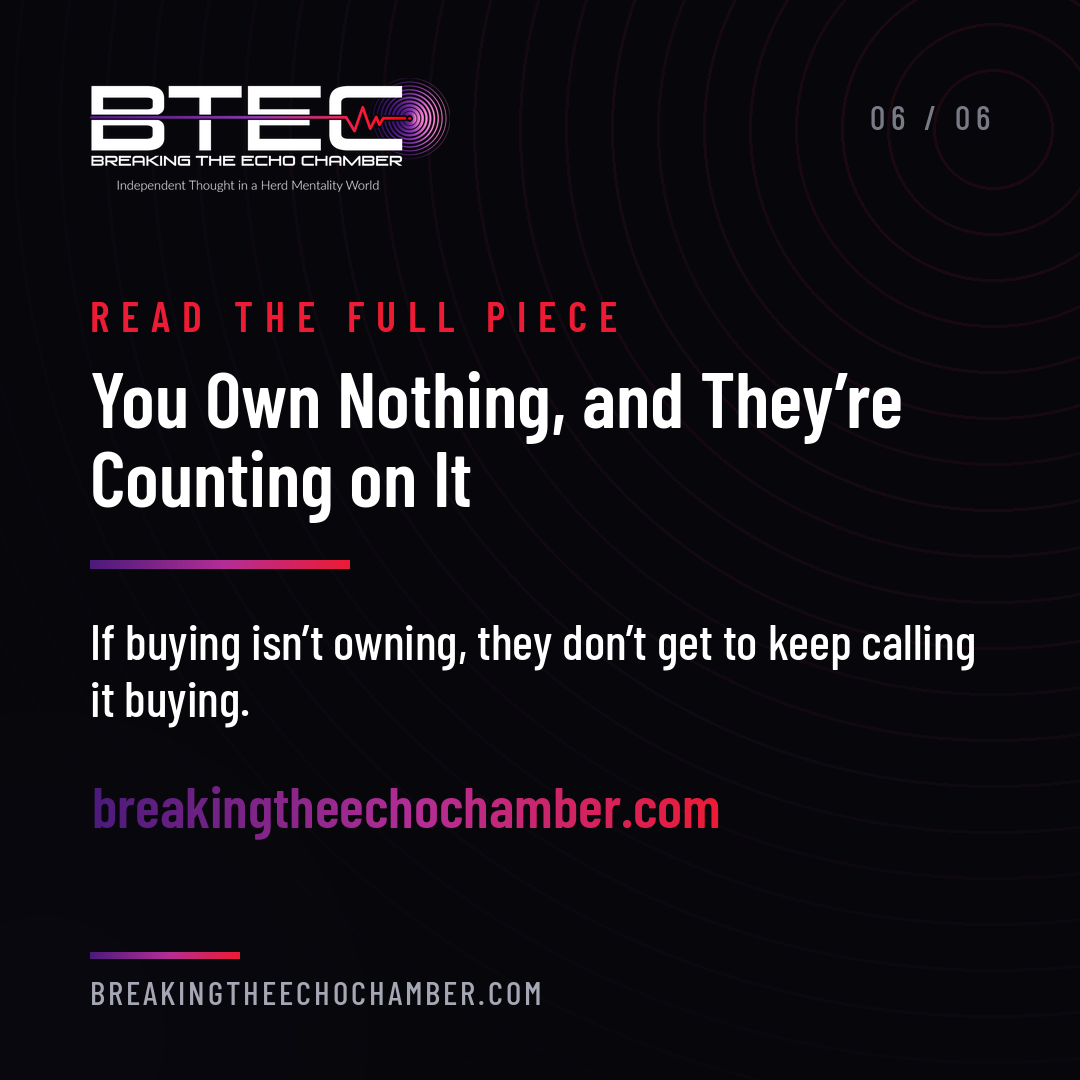
This week Sony reminded a few hundred thousand of its customers what they’d actually purchased. The answer was nothing.
On September 1, 2026, 551 movies and TV shows disappear from PlayStation Store libraries. Not from the storefront — from the accounts of people who already paid for them. Terminator 2. Total Recall. The Deer Hunter. From Dusk Till Dawn. Hot Fuzz. All gone, because a licensing deal Sony had with the distributor StudioCanal quietly lapsed. The notice tells buyers their films will be “removed from your video library.” That’s the whole message. No apology, no refund, no replacement — a polite corporate shrug and goodbye to the thing you thought was yours.
Buy Terminator 2 on Blu-ray in 2010 and it’s on your shelf today. It’ll be there in 2040, whatever deal Sony signs or doesn’t. “Buy” it on PlayStation and it evaporates the moment a contract you never saw expires. Same movie, same money. One you own; the other you were allowed to borrow until further notice.
None of this is a glitch. It’s the business model, and it has crept into nearly every digital thing you pay for: games, films, music, the software you use to earn a living. We’ve been quietly retrained to rent our own belongings back from the people who sold them to us, and most of us signed off without reading a word. So let’s read the words.
The word “buy” has been hollowed out
Here’s the lie, stated plainly. When you click Buy on Steam, the PlayStation Store, Xbox, the Nintendo eShop, Apple, Google Play, or Amazon Prime Video, you aren’t buying the game or the movie or the album. You’re buying a revocable licence — permission to reach a copy that lives on someone else’s machine, on terms they can change or cancel whenever it suits them.
The platforms know it. Lately they’ve even started admitting it, in font sizes engineered to be skipped. Amazon is currently defending a class-action suit in U.S. federal court, filed in August 2025, over exactly this bait-and-switch: the lead plaintiff says she paid around twenty dollars to “buy” a children’s show on Prime Video, then lost access to it. Amazon’s own terms call what you get a non-exclusive, non-transferable, limited licence, and warn that your “purchased” content may vanish because of licensing changes “or for other reasons,” with Amazon owing you nothing.
Or for other reasons. You bought a film; they kept the right to take it back for reasons they never have to name, and to keep your money while they do. That single clause is the foundation the whole digital economy is poured on, and it sits in exactly the place people never look.
How we got here: the slow boil
None of this arrived overnight. It came the way most quietly catastrophic things do — one reasonable-sounding step at a time.
We owned our records, then our cassettes, then our CDs and DVDs. Owned them so completely the question never came up. You could lend a CD to a friend, sell it, leave it to your kids, dig it out and play it thirty years later. Then music moved to the cloud, films moved to streaming, games moved to digital stores, and somewhere in that migration ownership got swapped for access. Almost nobody was told.
Software led the way, and proved how profitable the trick could be. In 2013 Adobe killed perpetual licences for its creative tools and pushed its entire customer base onto Creative Cloud: pay every month, forever, or lose the programs your career runs on. Stop paying and the software stops working — sometimes taking your files hostage with it. Microsoft has spent a decade herding people toward 365 subscriptions, and in October 2025 it ended support for Windows 10 outright, nudging millions toward new hardware or paid “extended security.” The perpetual licence, buy-once-own-forever, has been hunted to near-extinction and replaced with a meter that never stops running.
Games were next, and this time the industry said the quiet part out loud. In January 2024 Ubisoft’s own director of subscriptions told an interviewer that players would need to get comfortable “with not owning your game,” the way we’d given up our CD and DVD collections. The internet did not take it well. It also wasn’t wrong about where things were heading.
Then Ubisoft proved the point about as cruelly as possible. In 2024 it shut down the servers for The Crew, a racing game people had paid full price for, and the game became permanently unplayable — even for anyone holding a physical disc. The disc was now a coaster. The class-action that followed opens with an image you feel in your gut: imagine buying a pinball machine, then wandering into your den one day to find the paddles gone, the ball gone, the bumpers gone, your high score wiped, because the company decided you were finished playing.
The subterfuge: it’s not just what they sell, it’s how
The dishonesty doesn’t end at the word “buy.” It’s baked into the whole experience.
Watch how the choices get framed. $19.99 to rent, $24.95 to “buy” — except the “buy” hands you a licence that can be revoked, so you’ve paid a premium for the illusion of permanence. Watch the search funnels: you go looking for a film on a service you already subscribe to, and somehow it’s locked behind an extra charge, your subscription mysteriously not enough for the one thing you wanted to watch. Then there are the fees that only appear at checkout, the cancellation flows built like escape rooms, the free trials that auto-convert, the price that is never quite the price.
And here’s what should make people angriest, because it happens to be true: none of it is necessary. The technology to give people permanent, downloadable, offline-capable ownership of what they pay for has existed for decades. We had it. What stands between you and real ownership isn’t a technical wall — it’s arbitrary licensing and the pull of recurring revenue. A business decision to keep you paying for something you’ll never actually hold.
Some of the most honest voices on this are inside the industry. The publishers still pressing physical games, the developers shipping DRM-free, the storefronts built on offline installers will tell you flatly that digital should have fixed ownership forever and instead made it far worse. When the people who profit from selling you things start warning you about how they’re sold, it’s worth listening.
The fight back — and why it’s on a knife’s edge right now
Here’s where it stops being a complaint and turns into a movement.
Sparked by The Crew, a campaign called Stop Killing Games — started by the YouTuber Ross Scott — set out to force one simple principle into law: if a company sells you a game, it shouldn’t be able to reach back in later and destroy it. Not “support every game forever,” which is how the industry likes to caricature the demand. Just this: when you switch off the lights, leave people a way to keep playing what they paid for. An offline mode. The server code. The tools to host it themselves.
It went global, and it got loud. The European Citizens’ Initiative gathered more than 1.29 million verified signatures and was formally submitted to the European Commission in January 2026. A UK Parliament petition pulled nearly 190,000. And in the United States — a country the movement had all but written off as legally hopeless — California’s Assembly passed the Protect Our Games Act (AB 1921) on May 27, 2026, by 43 votes to 16. The bill would force publishers to give 60 days’ notice before pulling the plug and then leave buyers with a playable version, a patch, or a full refund. It’s now in the State Senate. California has also required storefronts since January 2025 to disclose that “buy” means “licence” — which is precisely the lawsuit Amazon is now staring down.
So the momentum is real. Don’t mistake it for victory, though, because the establishment is already pushing back hard. On June 16, 2026, the European Commission delivered its response and declined to propose any law requiring games to stay playable. It offered “exchanges” and a promise to review its digital-content rules by the end of 2026. Translated: after 1.29 million signatures, Europe’s answer was we’ll think about it. The games industry’s trade bodies — the same ones fighting AB 1921 in California — argue that ownership rules are “too expensive,” and that asking them not to destroy what they’ve sold is somehow the same as demanding products last “forever.”
It isn’t the same, and they know it. “Forever” is a strawman. “Don’t reach into my house and delete what I paid for” is the actual ask. This fight is winnable, but it’s being fought right now, in real time, against corporations with lobbyists, lawyers, and the inertia of a public trained not to read the fine print. This is the moment that decides whether digital ownership survives or gets quietly legislated into the grave.
The Canadian underbelly — and it’s worse than you think
If you’re reading this from Canada, here’s the part nobody mentions, and it’s genuinely maddening.
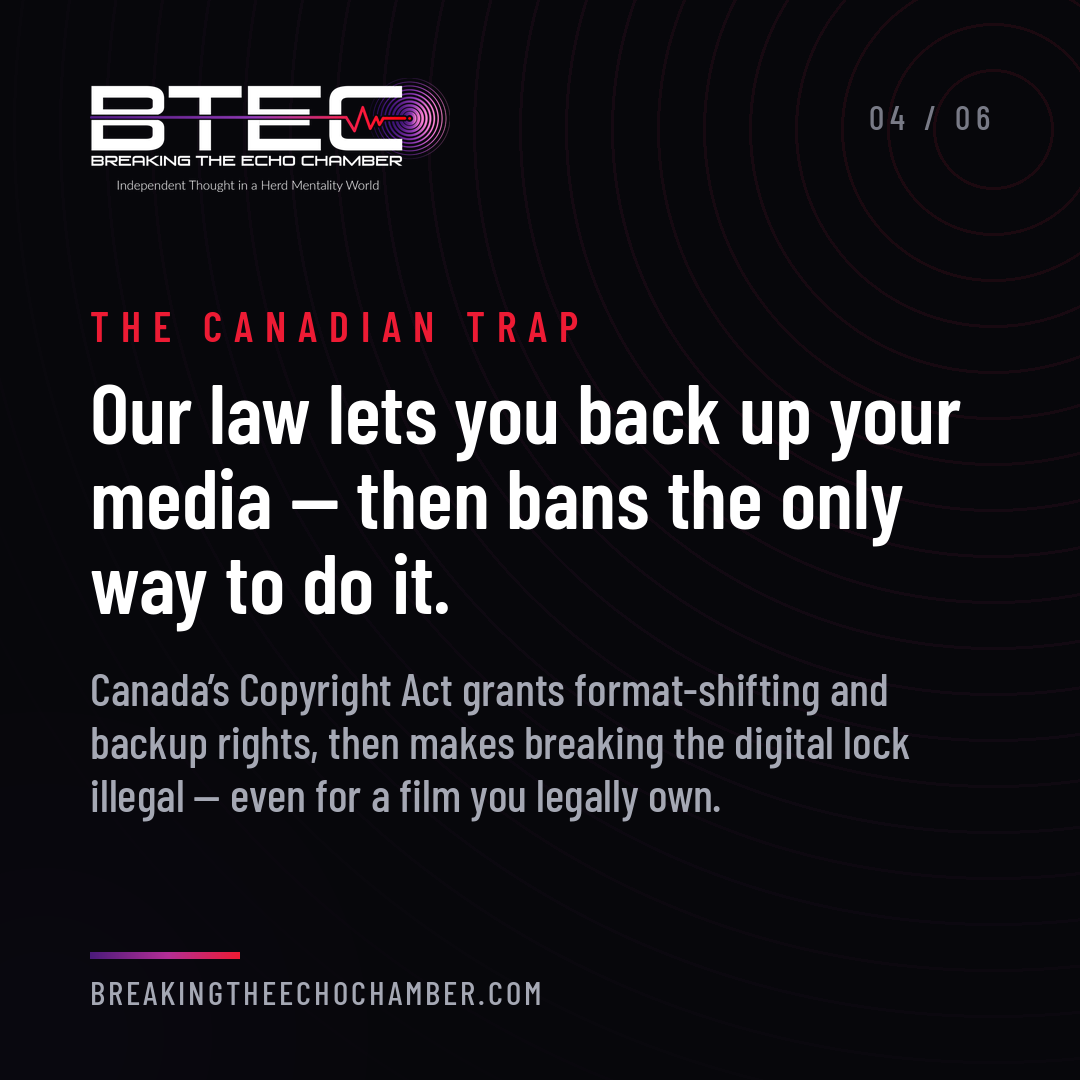
Canadian copyright law pretends to give you rights. The Copyright Act formally lets you make backup copies, time-shift a broadcast, format-shift your own media. Sounds fair. Now the trap: every one of those rights vanishes the instant a “digital lock” is involved. Under the 2012 Copyright Modernization Act — whose anti-circumvention rules were called, at the time, the most restrictive in the world — it’s illegal to break the DRM on something you legally bought, even for a completely lawful personal use. Want to back up a movie you own so it doesn’t evaporate like those 551 PlayStation titles? If it has a lock, breaking that lock to use your own backup right is itself against the law. The country hands you the right in one clause and criminalizes the only way to exercise it in the next.
It gets bleaker. Canada has no equivalent to California’s AB 1921 forcing publishers to leave games playable, and nothing like California’s disclosure law making storefronts admit “buy” means “licence.” Parliament did open the door a crack with Bill C-244, the right-to-repair bill that received Royal Assent in November 2024 — you can now legally break a digital lock to diagnose, maintain, or repair a device. But that carve-out is for fixing your tractor or your phone. It does nothing for the film or game or album dissolving out of your library. Media preservation stays locked out.
But Canada has also shown it can bite when the deception is blatant enough, and that matters. The Competition Act was amended in 2022, then strengthened again in 2024, to outlaw “drip pricing” — advertising a price you can’t actually pay because mandatory fees get bolted on later. When Cineplex buried a $1.50 online booking fee, the Competition Bureau went after it, and in 2024 the Competition Tribunal hit the company with a $38.9 million penalty, a ruling the Federal Court of Appeal upheld in January 2026. A buck-fifty fee; nearly forty million dollars in consequences, because regulators decided hiding the true price from Canadians wasn’t acceptable.
That’s the template — proof regulators can act when they choose to. But the Cineplex case also exposes the next, uglier layer of the con: even when these companies get caught, the people they ripped off almost never see a cent.

And even when they lose, you don’t win
This is the part that pushes the whole thing from infuriating to radicalizing. On the rare occasion one of these companies is caught and fined, the consumer — the actual person overcharged, misled, or stripped of what they paid for — sees little or none of it. The system is rigged at both ends.
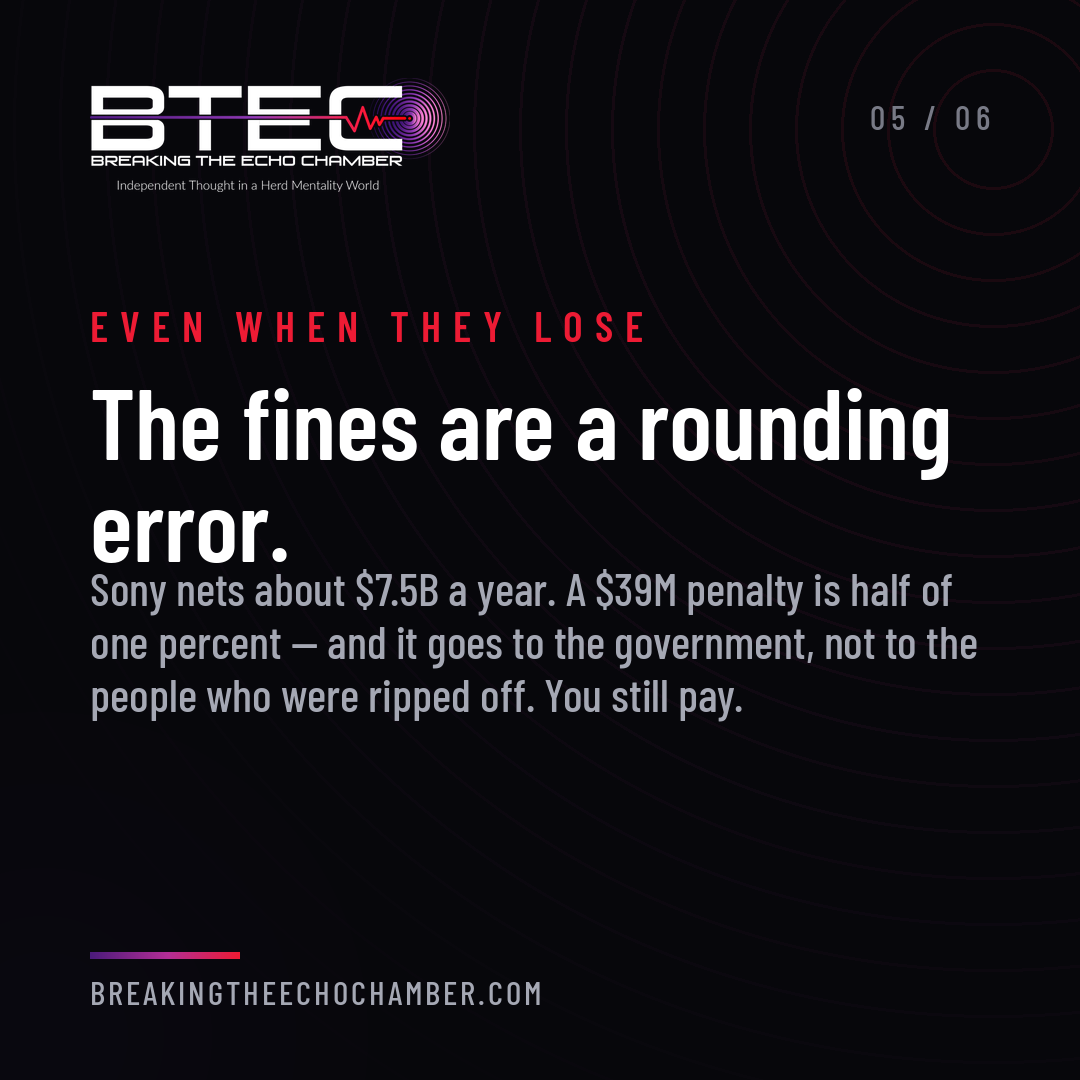
Start with the size of the fines. To a corporation this big, a “multimillion-dollar penalty” isn’t a punishment; it’s a line item. Sony’s net income in its most recent fiscal year was roughly $7.5 billion. A $39-million ruling against a company that size is about half of one percent of a single year’s profit — a parking ticket on the windshield of a Ferrari. Canada’s own Competition Bureau says the quiet part out loud, arguing that penalties have to be large enough that companies don’t treat them as “simply a cost of doing business.” Which is a confession that, at current sizes, that’s exactly what they are. The fine gets budgeted in advance, like spoilage or shipping, and the scheme still clears a profit.
Now follow the money. When a Canadian regulator wins a deceptive-marketing case, where does the penalty go? Not to you. Penalties under the Competition Act are paid to the Receiver General and disappear into the Consolidated Revenue Fund, the federal government’s general bank account — the Supreme Court of Canada has confirmed that’s where the money lands. The people actually harmed get nothing out of it. In the Cineplex case the Tribunal could have ordered the company to repay consumers, and expressly declined, citing the inconvenience of distributing it. So that $38.9 million, which happened to match the exact amount Cineplex skimmed in hidden fees, went to government coffers, and the customers who paid those fees had to launch separate class actions just to try to claw back a slice of their own money.
Sit with the sequence for a second. A corporation quietly overcharges millions of people, gets caught, pays a survivable fine — and that fine becomes government revenue, an undifferentiated pile of cash spent on whatever the government of the day likes, with no connection to the harm and not one word of input from the people who were fleeced. You were robbed, the robber paid a toll to the state, and you were never even in the room.
Where the law does try to route money back to consumers, the math insults the injury. When the U.S. trade regulator hit Amazon with a “historic” $2.5-billion settlement in 2025 over deceptive subscription tactics, the headline sounded enormous — until you read the terms. A billion of it went straight to the government as a civil penalty, and the consumer refunds were capped at $51 a person, for years of unwanted charges. Amazon, which pulls in hundreds of billions in revenue, settled three days into the trial precisely to cap its exposure below whatever a jury might have handed down. The “record-breaking punishment” was, from Amazon’s side of the table, a bulk discount.
Even the class actions that do reach consumers tend to be their own punchline: settlements paid in coupons, account credits, or cheques small enough to laugh at, while legal fees and administrators quietly soak up the real value. However the case resolves, the pattern holds. The corporation carries on, the government or the lawyers get paid, and the consumer — the only party actually wronged — is left holding a token, or nothing.
That’s why “well, they got fined” should never pass for justice. A fine the company shrugs off, paid to someone other than the victim, is neither deterrent nor remedy. It’s a toll on a road they fully intend to keep driving. Until penalties are big enough to genuinely hurt and are built to send money back to the people harmed, getting “caught” is just one more cost of doing business — and you, the customer, are the one who ultimately covers it.
It’s exactly like the house you don’t really own
Think of it this way. You scrimp and save and “buy” a house, and the land under it, and it feels like the most permanent thing in the world. Then you read the fine print and find that beneath the surface the bank holds the mortgage and the government holds powers of taxation and seizure, and that under the right — or wrong — circumstances they can take it, and you, the “owner,” are largely powerless to stop them.
Digital “ownership” is that, minus even the pretense. At least the homeowner gets warnings, due process, a deed. The person who “bought” Terminator 2 on PlayStation gets an email and a deadline. You’re not the owner of your digital library; you’re a tenant who paid the full purchase price and got none of the rights.
What to actually do about it
Outrage that goes nowhere is just content. So here’s where it goes.
Own what can still be owned. Buy physical media when it matters to you — discs and cartridges are copies you hold, not licences you borrow. For PC games, buy from DRM-free storefronts like GOG, which hand you standalone offline installers you can download, back up to your own drive, and run forever with no client, no account, no internet. For music, Bandcamp still lets you download and keep what you pay for. Baldur’s Gate 3, one of the most acclaimed games of the decade, shipped DRM-free. It can be done. Reward the companies that do it.
Treat “Buy” as “Rent — Until Further Notice.” Until the law forces honesty, assume every digital “purchase” is revocable and spend accordingly. If losing it would hurt, own it physically or DRM-free, or pull a backup the moment you’re allowed to.
Vote with your wallet, loudly. Subscriptions and licensed stores only win if we keep feeding them on autopilot. Cancel the ones you don’t need. Tell the platforms why. Buy from the ones that respect ownership.
Then make it political, because this is the part that actually changes things:
- Support Stop Killing Games and the push to fold real ownership protections into the digital-fairness laws now being written. That pressure is what’s kept the issue alive since the EU’s June brush-off.
- In Canada, write to your MP and to Innovation, Science and Economic Development Canada (ISED) demanding a Canadian version of California’s ownership-disclosure and game-preservation laws, and an end to the digital-lock rules that criminalize backing up your own media.
- Push your provincial consumer-protection ministry — these rules are provincial too — to define “buy” honestly and to treat disappearing digital purchases as the deceptive practice they are.
- Report deceptive “buy” buttons and hidden fees to the Competition Bureau. The Cineplex ruling proves complaints can turn into consequences.
- Demand penalties that actually bite and actually compensate. A fine a corporation shrugs off, paid into general revenue instead of back to the people harmed, fixes nothing. Tell lawmakers consumer-protection penalties should scale to a company’s revenue and be routed to the victims, not quietly absorbed into the treasury.
Preserve. Back up what you legally own. Support libraries, archivists, and the people doing the unglamorous work of making sure the culture of this era still exists in fifty years — because the corporations selling it have shown, over and over, that they’ll let it rot the second it stops turning a profit.
The line in the sand
For most of human history, if you paid for a thing, it was yours. That plain, ancient bargain — money for goods, goods you keep — is being dismantled in broad daylight, one unread terms-of-service at a time, and a whole generation is being raised to believe that paying full price for permission is normal.
It isn’t normal. It’s a quiet, coordinated repossession of ownership itself, dressed up as convenience, and it will keep advancing for exactly as long as we keep clicking “Buy” and pretending the word still means something.
So make it mean something. Own your copies. Read the fine print and walk away from the bad deals. Back the laws, sign the petitions, write the letters, support the developers and stores who still think you should keep what you pay for. And the next time a company deletes 551 movies out of the libraries of the people who bought them, don’t shrug. Get loud.
Sources & further reading
- Kotaku / CBR / Boing Boing — PlayStation removing 551 StudioCanal titles from accounts, effective Sept 1, 2026 (June 2026)
- Hollywood Reporter / ClassAction.org — Reingold v. Amazon class action over Prime Video “purchases” and California’s digital-goods disclosure law (AB 2426), in effect Jan 2025 (Aug 2025)
- PC Gamer / Techdirt — Ubisoft’s Philippe Tremblay on “not owning your game” (Jan 2024)
- GameHazards / Polygon — The Crew shutdown and the Cassell v. Ubisoft class action; Steam and GOG licence/ownership disclaimers (2024–25)
- Wikipedia: Stop Killing Games; European Citizens’ Initiative — “Stop Destroying Videogames” submission and the Commission’s reply (June 16, 2026)
- Engadget / Inven Global / Gamermarkt — California AB 1921, the Protect Our Games Act, passed Assembly 43–16 (May 27, 2026); ESA opposition
- Norton Rose Fulbright / EFF / SFU Library — Canada’s Copyright Modernization Act (Bill C-11, 2012) anti-circumvention rules; Bill C-244 right-to-repair amendments (Royal Assent Nov 7, 2024)
- Competition Bureau Canada / Federal Court of Appeal — Cineplex drip-pricing ruling, $38.9M penalty upheld (Jan 21, 2026); Competition Act drip-pricing provisions (2022, strengthened 2024); Tribunal declined consumer restitution
- FTC / CNBC — Amazon’s $2.5B Prime settlement: $1B civil penalty to government, $1.5B consumer refunds capped at $51/person (Sept 25, 2025)
- Sony Group FY2024–25 financial results (SEC Form 20-F / 6-K); Macrotrends — annual net income ≈ $7.5B
- Receiver General / Consolidated Revenue Fund: Financial Administration Act; Guindon v. Canada (SCC) — where administrative monetary penalties are paid; Competition Bureau on penalties as a deterrent against “a cost of doing business”