
Uncommon Sense · Long read
Everybody’s History
A global accounting of slavery — who enslaved whom, where, when it ended, what ended it, and why it hasn’t.
Ask most people in North America to describe the history of slavery and you will get one of two answers. In the United States, it is a story about white people and Black people, running roughly from 1619 to 1865. In Canada, it is a story about settlers and Indigenous peoples, and it is often not about slavery at all but about residential schools, which is a different crime with a different shape. Both answers describe something real. Both are also, as accounts of the institution, roughly as complete as describing the ocean by pointing at a wave.
Slavery is not a chapter in the history of one continent. It is a load-bearing feature of nearly every complex society humans have ever built, on every inhabited continent, for at least five thousand years. Sumerians enslaved Sumerians. Greeks enslaved Greeks — Sparta held an entire neighbouring Greek population in hereditary bondage for three centuries. Koreans enslaved Koreans, and for four centuries more than three in ten people in the country were held in a status their own historians are still arguing about. Vikings raided Ireland for bodies and sold them through Dublin. The English word slave most likely comes from Slav, because for a few centuries the Slavic peoples of eastern Europe were the export commodity. North African corsairs raided Iceland. West African states raided each other, and sold the results into a European market they did not build but did supply. The Comanche ran a captive economy on a scale that reshaped a continent’s interior. The Tlingit and the Haida held slaves on the Pacific Northwest coast. Rome, Baghdad, Delhi, Zanzibar, Lisbon, Charleston, Bristol, Rio, Muscat — the ledger is very long and almost nobody is missing from it.
This matters for a reason that has nothing to do with scorekeeping. When you believe slavery was one culture’s crime against one other culture, you conclude that the problem was that culture, and that the solution was ending that culture’s power. When you look at the whole record, a different pattern shows up, and it is considerably less comfortable: in almost every society that practised slavery, the people who profited from it were a small, wealthy, organised minority, and the people who paid for it — in bodies, in wages undercut, in militia service, in taxes — were the ordinary poor of every colour involved, on both sides of the transaction.
That is not a theory I am asking you to accept. It is a pattern you can watch assemble itself out of the receipts below. And where the record complicates it — where race was doing work that class alone cannot explain, and it demonstrably was, particularly in the Americas — I have said so, in the same voice and at the same volume. An article that only works if you don’t look closely isn’t worth writing.
Everything here is cited. Numbers come from peer-reviewed scholarship, university presses, national archives, government statistics and the major academic databases — principally the Trans-Atlantic Slave Trade Database at Emory and Rice, the ILO’s Global Estimates of Modern Slavery, and UCL’s Legacies of British Slavery. Advocacy-organisation figures are used sparingly, always labelled as such, and always with the methodological criticism attached.
Contested numbers are marked contested, and given as ranges. Historical population estimates are reconstructions, not counts. Where serious scholars disagree by a factor of two — and for the ancient world they routinely disagree by a factor of five — you will see the range and the names, not a tidy single number. A single number you can’t defend is worse than a range you can.
Where I could not verify something, I left it out. Several famous, widely-quoted facts about slavery did not survive checking — including one very well-travelled quotation from an African king that is reproduced in a thousand arguments and which I could not trace to any page of any edition of the book it is attributed to. It is not in this article. Neither are several numbers you may have seen elsewhere. That absence is deliberate.
This article takes no position on any contemporary policy question — not reparations, not curriculum, not immigration, not anything. It reports what is documented. What you do with it is your business.
Contents
- 1.What slavery actually is
- 2.The Bronze Age: where the paperwork starts
- 3.Greece and Rome: the ancestors everyone claims
- 4.Asia: the largest systems nobody mentions
- 5.Europe enslaving Europe
- 6.The Sahara, the Indian Ocean and the Barbary coast
- 7.Africa: the hardest section to write honestly
- 8.The Indigenous Americas, before and after
- 9.The Atlantic system: what actually made it different
- 10.Canada’s blind spot
- 11.Follow the money: who actually profited
- 12.How it ended, country by country
- 13.It didn’t end
- 14.What the record supports — and what it doesn’t
- 15.The argument appendix: 18 contested claims
- 16.Sources
1. What slavery actually is
Most arguments about slavery are really arguments about definitions, conducted by people who have not agreed on one.
There is an internationally agreed legal definition and it is a hundred years old. The League of Nations Slavery Convention, signed at Geneva on 25 September 1926 and in force from 9 March 1927, defines it in one sentence: “Slavery is the status or condition of a person over whom any or all of the powers attaching to the right of ownership are exercised.” That definition is still operative in international law today.1
It is a good definition because it is about ownership, not about cruelty. Cruelty is a variable. Ownership is a legal status. A kindly master and a monstrous one are both exercising the powers attaching to a right of ownership, and both are slaveholders. Conversely, an employer who treats you appallingly is not a slaveholder, because they do not own you. This distinction does an enormous amount of work later in this article, and it is the reason the “the Irish were slaves too” argument collapses the moment you apply it.
The most influential scholarly definition comes from the Jamaican-American sociologist Orlando Patterson, who in Slavery and Social Death (Harvard, 1982) surveyed sixty-six slaveholding societies across history and identified three elements he found in all of them: natal alienation — the enslaved person is severed from ancestry and descent, has no legally recognised parents and can pass nothing to children; generalised dishonour — a permanent status degradation independent of conduct; and permanent violent domination.2 Patterson is worth naming early because he is a genuinely double-edged source in these arguments. He is the strongest scholarly authority for the claim that slavery was near-universal — and he is also among the strongest for the claim that the New World version was structurally extreme. Both things are in the same book.
Three further distinctions will save a lot of trouble:
- Chattel slavery — the enslaved person is legally property: purchasable, saleable, heritable, inventoried alongside livestock. This is the form the Atlantic system took, and it is also the form Chosŏn Korea took, and Rome, and much of the Islamic world.
- Serfdom and other bound labour — the person is tied to land or to a lord and cannot leave, but is not, strictly, owned. In practice the line blurs badly. The historian Richard Hellie’s summary of the Russian case is that serfdom “began in 1450, evolved into near-slavery in the eighteenth century, and was finally abolished in 1906” — note that he dates real abolition to the Stolypin reforms, not the famous 1861 Emancipation Manifesto.3
- Indentured servitude — a contract, for a defined term, with legal recourse, ending in freedom and often in a payout. Brutal, frequently lethal, sometimes coerced, and categorically not the same institution. More on this in the appendix.
Historians increasingly write “enslaved person” rather than “slave,” on the grounds that slavery was a condition imposed on people, not an identity they possessed. I use both in this article: the second construction for people, the first where the source, the statute or the legal category demands it — the Domesday servi, the Korean nobi, the Roman servus. Where I quote a document, I quote it as written, including its spelling.
2. The Bronze Age: where the paperwork starts
Slavery is older than writing. We know this because the earliest writing already takes it for granted.
The Laws of Hammurabi — 282 legal judgements cut into a two-and-a-quarter metre pillar of black basalt around 1750 BCE, now in the Louvre — are not a founding document of slavery. They are a mature regulatory framework for an institution already so established that it needs consumer-protection provisions.4 Law 278 gives a thirty-day warranty on a purchased slave who turns out to have the benu-disease. Law 231 provides that if a shoddily built house collapses and kills the owner’s slave, the builder “shall pay slave for slave.” Law 282: “If a slave say to his master: ‘You are not my master,’ if they convict him his master shall cut off his ear.”5
Two provisions are worth sitting with, because they establish patterns that recur for the next four millennia. Law 117 — debt bondage — provides that a man who cannot meet a debt and sells his wife, son and daughter into service sees them work three years in the buyer’s house and go free in the fourth.6 That is a time-limited institution with an exit. Compare Law 175: if a slave marries a free man’s daughter and they have children, “the master of the slave shall have no right to enslave the children of the free.” Babylonian law is already, in 1750 BCE, tracking status through the mother in a way that limits the slaveholder. Three and a half thousand years later, Virginia would run that same rule in reverse, and the difference is most of the story of the Atlantic world.
“Slaves built the pyramids.”
They did not, and this is not a fringe revisionist position — it is the settled consensus of the archaeologists who dug the site. Mark Lehner’s excavations at Giza between 1999 and 2002 exposed some five hectares of a purpose-built workers’ settlement, including barracks for a rotating labour force, an administrative complex and the oldest bakery yet found in Egypt. The faunal analyst Richard Redding recovered cattle, sheep and goat bone in quantities sufficient “to feed several thousand people, even if they ate meat every day” — and mostly young male cattle, which is prime beef. Zahi Hawass excavated the workers’ cemetery above the settlement; the skeletons show the work was punishing, with healed fractures and spinal stress, but the men were buried in tombs, with grave goods, in the shadow of the thing they built. Slaves are not given cemeteries next to the pharaoh.7
The documentary confirmation arrived in 2013, when Pierre Tallet found the oldest inscribed papyri known at Wadi al-Jarf on the Red Sea. The “Diary of Merer” is a work log kept by an inspector supervising a crew of about two hundred men ferrying Tura limestone up the Nile for the Great Pyramid’s casing, recorded in half-day increments, in Khufu’s twenty-seventh year. The men were issued meat, poultry, fish and beer.8
What the evidence describes is corvée — obligatory state labour service, organised in named gangs on a rotation, drawn from a free peasantry. Egypt did hold enslaved people, particularly foreign prisoners of war in the New Kingdom, designated sqr-ʿnḫ, “bound for life.” But as the Egyptologist Antonio Loprieno observes, Egyptian has no single word for “slave,” and “the virtual absence of legally codified slavery in a society so keen on written documentation cannot be accidental.”9 The pyramid-slave story is not Egyptology. It is Herodotus, writing two thousand years after the fact, laundered through Cecil B. DeMille.
Five thousand years, seven regions
Legal slavery as a documented institution, by region. Bars mark the span over which the institution is attested in law, administrative record or contemporary account — not continuous uniform practice, and not intensity. Dates for the ancient world are approximate by nature.
3. Greece and Rome: the ancestors everyone claims
The two civilisations Western democracies name themselves after ran on enslaved labour, and one of them enslaved an entire neighbouring people for three centuries.

Athens
How many enslaved people lived in classical Athens is the single most contested number in ancient history, and the honest answer is a range that spans a factor of nearly six. A. H. M. Jones put it at about 30,000 in the fifth century and 20,000 in the fourth; Walter Scheidel at 30,000–50,000 maximum; Michael Jameson at 50,000 as a minimum; Mogens Herman Hansen at 66,000–93,000; Moses Finley at 80,000–100,000 at peak; A. W. Gomme at 100,000–115,000 in 431 BCE. Ben Akrigg’s recent study rejects anything above 100,000 as unrealistic, and establishes a useful hard floor from the other direction: Athens needed at least 20,000 able-bodied adult male slaves for military purposes alone — hoplite attendants and trireme crews — before you count a single woman or a single non-military man. Nemanja Vujčić’s 2021 assessment lands at “hardly larger than ca. 100,000 and likely below that, though almost certainly not below 50,000” — somewhere between 15 and 30 per cent of the total population, fluctuating by decade.10
Give the range. Never give a point estimate. Anyone who tells you confidently that “a third of Athenians were slaves” is quoting the top of a spread they haven’t looked at.
What is not contested is the character of the thing. Xenophon, arguing in Ways and Means that the Athenian state should get into the slave-leasing business, mentions in passing that Nicias son of Niceratus owned a thousand men working the Laurion silver mines and rented them out at an obol a day each, that Hipponicus leased out six hundred, and Philemonides three hundred.11 Aristotle, in Politics Book I, works out the philosophical justification with a clarity that has embarrassed his admirers ever since: property is a collection of tools, some lifeless like a rudder and some living, and “a slave is a live article of property” — “one who is a human being belonging by nature not to himself but to another is by nature a slave.”12
Note carefully what Aristotle concedes at 1255a: that there is also slavery by law and convention, which is a different thing from his natural slavery, and that this distinction was already argued about in his own lifetime. The claim that nobody in the ancient world questioned slavery is false, and it is false on the testimony of the ancient world’s most famous defender of it.
Sparta: Greeks enslaving Greeks, as state policy
The helots of Laconia and Messenia were not foreign captives. They were Greeks, held collectively by the Spartan state, whose subjugation the classicist Paul Cartledge describes as being “enslaved as a nation.”13 Plutarch, writing on Lycurgus, reports the krypteia: Spartan magistrates would send the ablest young men into the countryside “armed only with their daggers” to kill helots by night and in the fields by day. He adds, on Aristotle’s authority, that the ephors formally declared war on the helots each year “that they might be massacred without a breach of religion” — a legal device to make the killing of a subject population ritually clean. Helots were also made to drink to excess and perform degrading songs in front of Spartan children, as a pedagogy of contempt.14
Plutarch himself doubts Lycurgus instituted this, suspecting it postdates the great helot revolt, and the modern scholarship is properly contested: Nino Luraghi argues the mass-enslavement narrative reflects ideologically selective reading of the sources; Hans van Wees situates the Spartan conquest within a broader wave of archaic Greek imperialism in which many city-states reduced their neighbours to serfdom between roughly 750 and 550 BCE.15 That correction makes the picture worse, not better: it means Sparta was not an aberration but an unusually well-documented instance of something several Greek states did. Messenian helotage ended in 369 BCE when Epaminondas of Thebes, having broken Sparta at Leuktra, marched into Messenia and founded the city of Messene — abolition by foreign invasion, three hundred years late.16
Rome
The estimates for Roman Italy diverge as widely as the Athenian ones and for the same reason. Karl Julius Beloch said two million out of six; P. A. Brunt said three million; Keith Hopkins said 800,000; Walter Scheidel’s bottom-up model gives 1.0–1.5 million and no more. Noel Lenski’s 2023 synthesis offers the currently safe formulation: 15 to 25 per cent of Italy’s population, roughly 1 to 1.5 million out of 6 to 7 million, in the High Empire. Census data from Roman Egypt independently suggests about 11 per cent there, which may be more representative of the provinces.17
Where did they come from? Lenski ranks the sources: first and largest, birth to enslaved mothers; then military capture — Caesar reportedly enslaved something like a million Gauls, Titus took 97,000 Jews after Jerusalem fell in 70 CE; then market purchase; then exposed infants reclaimed from abandonment; then child sale and debt bondage; then trafficking among frontier peoples, Irish, Scots, Frisians, Goths and Arabs among them.18 W. V. Harris argues child exposure was significantly underestimated by earlier scholars, and that self-sale was more common than assumed.19 Nobody in this literature thinks Roman slavery was racial. It could not have been: it drew on everyone within reach, including Romans.
Strabo writes that the market at Delos “could both admit and send away ten thousand slaves on the same day,” and preserves a merchants’ proverb: “Merchant, sail in, unload your ship, everything has been sold.”20 The line is quoted constantly, including in current scholarship. It cannot be a throughput rate. Scheidel’s model puts total slave imports into all of Italy at 15,000–20,000 per year; Strabo’s figure would have Delos alone clearing a full year’s Italian supply every day and a half, or roughly 3.65 million people a year. The Greek word is myrias, “ten thousand,” which in Greek idiom routinely means “an enormous number” rather than a count. Treat it as a rhetorical superlative. I flag it because it is a good example of a real primary source producing a fake statistic, and because articles like this one are how fake statistics get their citations.
Rome’s genuinely distinctive feature was the exit. Manumission was common, ritualised and legally structured — manumissio vindicta before a magistrate, manumissio censu by census enrolment, manumissio testamento by will — and a freed libertus became a Roman citizen with a vote. Crucially, the residual legal disabilities “were placed only on the former slaves themselves and did not apply to their sons.” In 2 BCE the lex Fufia Caninia had to be passed to cap the number of people a testator could free in his will, which tells you how routine it had become.21 Lenski estimates that perhaps more than 30 per cent of urban slaves over twenty-five could expect freedom.22 Christer Bruun, who works on the inscriptions, adds the necessary caution: these are models, not counts, and “on the very important question of the overall number of slaves in the Roman world, epigraphy cannot make a large contribution.”23
And the enslaved fought. The Third Servile War of 73–71 BCE began, according to Appian, when Spartacus “persuaded about seventy of his fellows to risk their lives for freedom” at a gladiatorial school in Capua. Within two years his army numbered in the tens of thousands. Crassus restored discipline in his own legions by decimation — drawing lots and executing every tenth man — and when it was over, six thousand survivors were crucified along the road from Rome to Capua.24 There had been two earlier servile wars in Sicily, in 135–132 and 104–100 BCE. Whatever people in the ancient world believed about the naturalness of slavery, the enslaved were not among them.
4. Asia: the largest systems nobody mentions
If you want a single case that breaks the “slavery is what one race did to another” frame, it is Korea — and it is not obscure. It is the best-documented mass slave society in East Asian history.
Korea: the nobi
Sun Joo Kim of Harvard opens her survey with the flat statement that “Chosŏn Korea (1392–1910) was one of the most enduring slave societies in world history.” Between the fifteenth and eighteenth centuries, enslaved people — nobi — comprised over 30 per cent of Korea’s population.25 They were Korean. Their owners were Korean. The system ran for five hundred years.
The economic historians Rhee Young-hoon and Yang Donghyu compared it directly to the antebellum United States and found that each institution held “about one-third share in population,” and that both were legally chattel — subject to sale and to inheritance.26 Their own conclusion, which I include because leaving it out would be dishonest, is that it is nonetheless “inappropriate to call the Chosŏn nobi slaves in general sense”: some nobi held property rights and civil protections, particularly on larger holdings, and the Korean system lacked the racial permanence of the American one. There is a genuine and unresolved “slaves or serfs?” literature here. Both halves of that finding matter. The share of population is not in dispute.
Regional variation was extreme. Figures reported in the secondary literature — which I flag as not verified at source — put the southern half of the country near 40 per cent in the fifteenth to seventeenth centuries, while in the north the status was not even hereditary, and record one surveyed district of Seoul in 1663 in which 1,729 of 2,374 residents, 73 per cent, were nobi.27 Abolition came in stages: government-held nobi were emancipated in 1801, roughly 66,000 people, and the registers were burned; hereditary slavery ended in 1886; and the Gabo Reform of 1894 abolished the status system entirely.28 That last date is worth holding onto. Korea abolished slavery twenty-nine years after the United States.
Enslaved people as a share of population
Selected societies, with scholarly ranges shown as bars rather than points. Where specialists disagree, the full spread is drawn. Hover or tap a bar for the source.
China
The Chinese legal category was nubi (奴婢), and its distinctive feature was status pollution: enslavement placed a person permanently in the jianmin (賤民), the “mean” or debased people, severed from liangmin, honourable society — barred from the imperial examinations, deprived of normal kinship privileges, treated as household members but permanently inferior.29 Claude Chevaleyre’s work argues against the widespread assumption that slavery did not really exist in late imperial China, finding “unprecedented numbers” of nubi by the late Ming, driven by commercialisation, with entry routes running from sale contracts through penal enslavement to outright trafficking and debt seizure. Nubi revolts erupted in more than thirty districts during the crisis of the 1630s to 1660s.30
There is no reliable aggregate count of nubi for any Chinese dynasty, and I will not invent one. What is documentable is the legal chronology. In 1723 the Yongzheng emperor began emancipating debased status groups — the yuehu musician households of Shanxi and Shaanxi first, then others by province — and by 1729 had to rename the state Bureau of Instruction because recruitment had collapsed once the category was abolished.31 The nubi category itself survived until 1909–10, when the Qing Commission of the Constitutional Government drafted a “Prohibition of Buying and Selling Human Beings” and incorporated it into the criminal code promulgated on 15 May 1910. Chevaleyre notes it was done under Western pressure, as part of the New Policies era, “without widespread public support or prior debates.”32 The legal chain then runs on for decades: an explicit offence of enslavement added in 1918, Chinese signature of the International Slavery Convention in 1926, a nationwide prohibition on keeping domestic slaves in 1932, further ordinances into the later 1930s.33 Formal abolition and actual extinction were about forty years apart.
India and South Asia
Under Firuz Shah Tughlaq of the Delhi Sultanate (r. 1351–88), the court chronicler records 180,000 slaves in Delhi; under Ala al-Din Khalji (r. 1296–1316), 50,000.34 Court chroniclers inflate, and these should be read as impressionistic rather than counted. More useful is the scholar Fouzia Farooq Ahmed’s conclusion applying Finley’s criteria: the Delhi Sultanate was “a society with slaves rather than a slave society” — huge slave numbers, but no large-scale slave peasantry, with agriculture running on free peasant labour and enslaved people filling urban roles as soldiers, artisans and builders.
The Mughal period saw domestic slavery and concubinage as the commonest forms, agrarian slavery significant in the south, and eunuch slavery in elite households. Akbar issued orders against enslaving the relatives of enemy combatants and banned slave sales; Jahāngīr banned the castration of eunuchs.35
The British case is where it gets instructive. The Slavery Abolition Act 1833 excluded British India. India got its own instrument ten years later: the Indian Slavery Act, Act V of 1843. Read what it actually does. It provides that no public officer shall sell a person on the ground of slave status; that “no rights arising out of an alleged property in the person and services of another as a slave shall be enforced by any Civil or Criminal Court”; and that any act which would be a penal offence against a free man is equally an offence against a person held as a slave.36 Notice what is missing: it does not criminalise slaveholding. It withdraws state enforcement and leaves the institution standing. Emma Kalb characterises the colonial approach as “abolition by denial”: the Act proved ineffective, enslaved people were simply re-designated “servants,” and agrarian slaves became “agrestic labourers” with conditions unchanged.37
India’s substantive instrument arrived in 1976: the Bonded Labour System (Abolition) Act, No. 19 of 1976, whose long title is worth quoting because of what it does not say out loud — “An Act to provide for the abolition of bonded labour system with a view to preventing the economic and physical exploitation of the weaker sections of the people.”38 “Weaker sections of the people” is the statutory euphemism for caste-linked debt bondage. That system is still running; see section 13.
Southeast Asia and Japan
The Sulu sultanate’s market at Jolo sold between 200,000 and 300,000 people between 1770 and 1870. Batavia housed roughly 27,000 people by 1673, about half of them enslaved.39 In Siam, society distinguished phrai — freemen owing corvée — from that, the enslaved, and the majority of the enslaved appear to have been Siamese themselves. Abolition under Chulalongkorn was gradual by design: a royal act in 1874 freeing those born into slavery since 1868 at age twenty-one; clarifying laws in 1884, 1890, 1897 and 1900; the Slave Abolition Act of 1905 introducing declining caps on redemption prices; explicit criminalisation in the Penal Code of 1908; and full legal cessation in 1915.40 The nationalist framing of Chulalongkorn as a Thai Lincoln is a later construction, and Thai historians have said so.
Japan’s ritsuryō codes ranked nuhi at the bottom of the “base people of five colours” — the finer details usually quoted about the system, including the ages at which government-held kunuhi were freed, rest on sources I could not verify and are left out here. And in 1587, in the eleven-article memorandum preceding his Bateren Edict, Toyotomi Hideyoshi banned the sale of Japanese people abroad: “It is unreasonable to sell Japanese to China, Nanban, and the Korean Peninsula. Therefore, in Japan, the buying and selling of people is prohibited.”41 He was banning something specific. Portuguese merchants had been buying Japanese people; a contemporary document records roughly a thousand loaded onto a single vessel bound for Macao in 1588.42 The first European slave trade in East Asia ran in the opposite direction from the one everybody knows about, and a Japanese warlord shut it down two hundred and twenty years before the British Parliament got round to the Atlantic.
5. Europe enslaving Europe
The English word for the institution is probably an ethnic slur, and the people it names were the commodity.

The standard lexicographic position is that slave descends from Slav: Middle English sclave, first attested around 1290, from Old French esclave, from Medieval Latin sclavus, from Byzantine Greek sklabos — a word that meant both “Slav” and “slave.” The American Heritage Dictionary puts it bluntly: “they are, in fact, historically identical.”43 The ethnonym itself is thought to derive from a Proto-Slavic root meaning renown or fame — the same element in names like Boh-slav — so the semantic collapse from “the famous people” to “property” happened entirely inside the medieval slave trade.
Being honest about this requires flagging a real dissent. Georg Korth argued in 1970 that the Greek ethnonym merely coincided with a pre-existing Greek word for unfree persons, producing a folk etymology rather than a genuine descent; Elmar Seebold adopted that view in Kluge’s Etymologisches Wörterbuch, the standard German etymological dictionary, and the Oxford etymologist Anatoly Liberman endorses it and advises abandoning the Slav–slave equation.44 The mainstream position remains the first one, but it is not unanimous, and it is worth saying so rather than deploying a contested etymology as a rhetorical trump card.
The trade underneath the word is not in dispute. Marek Jankowiak of Oxford estimates the tenth-century Slavic slave trade into the Islamic world ran “in the thousands of slaves per year,” inferred from roughly 400,000 Islamic silver dirhams recovered in Scandinavia and Slavic lands — itself, he notes, a small fraction of the total inflow. The route ran from Iraq via Khazaria in the ninth century, shifting after 900 to Samanid Central Asia by way of Bulgar.45 Eastern Europeans were being sold south and east in industrial quantity, for silver, six hundred years before Columbus.
The Vikings
Norse raiding was, substantially, a business in people. Poul Holm’s foundational study of Dublin found slave-taking integral to Viking warfare from the ninth century, peaking in the ninth and tenth, and — the detail that matters — that by the eleventh century Irish kings themselves were selling Irish war prisoners through Dublin.46 The Annals of Ulster record the plundering of Howth in 821 and the raiders “carried off a great number of women into captivity”; in the 940s an Irish bishop held on Dalkey Island died attempting escape; in 980 Máel Sechnaill stormed Dublin to release Irish captives; in 1098 Dublin ships in the Anglesey campaign were paid in “captives… of young men and maidens.”47
Proportions are genuinely uncertain and I will not pretend otherwise. The highest published figure — up to 25 per cent of Viking-Age Norway’s population held as thralls — comes from Jón Viðar Sigurðsson of Oslo.48 Stefan Brink’s Thraldom (Oxford, 2021), the standard modern treatment, deliberately declines to give a proportion at all, on the grounds that archaeological remains are scarce and ambiguous, that the written sources postdate the period, and that it is frequently impossible to distinguish unfree from free tenant farmers.49 Brink even prefers “thraldom” to “slavery” to avoid importing a Roman or modern frame. The right formulation is: estimates range widely, the highest is around a quarter for Norway, and the leading specialist declines to quantify.
England: 10 per cent, and then gone
The Domesday Book of 1086 records servi as the fourth-largest group among the English peasantry — over 10 per cent of the recorded population, and, as the Hull Domesday Project notes, significantly higher if you allow for their near-total omission from the northern circuit.50 Two caveats belong in the same breath: Domesday counts heads of household, not individuals, so this is 10 per cent of households; and the translation is itself disputed, with servus rendered “slave” in some editions and “serf” in others. John S. Moore is emphatic on the point, following Frank Stenton: “The servi and ancillae of Domesday Book are undoubtedly male and female slaves,” and mistranslating them as serfs collapses two opposite processes — slavery declining, serfdom rising — into one.51
English slavery then vanished within about two generations. Moore dates the completion of the decline to the reign of Henry I, 1100–1135. It was helped along by clerics: Wulfstan II, Bishop of Worcester, is credited with ending the Bristol slave trade to Ireland by repeated preaching — William of Malmesbury says he “gradually destroyed this long-standing custom, handed down from remote ancestors to their descendants” — and in 1102 Anselm obtained a resolution from the Council of London against the trade, aimed chiefly at the sale of English people into Ireland.52 That resolution also broke Dublin’s exchange network. In 1171 the Council of Armagh decreed that English slaves in Ireland be freed.
It did not vanish cleanly. Worcester Cathedral’s records carry more than 140 mentions of nativi, servi and ancillae, over 120 manumissions in the Liber Albus between 1301 and 1450, and a document of 1370 that reads as the outright sale of a man named Nicholas Salewy.53 And what replaced slavery was villeinage — unfreedom of a different legal shape, which the same peasants experienced as continuity.
Russia
Russia ran both institutions, in sequence. Hellie’s account is that medieval Russia had no serfdom, because land was abundant — but slavery, kholopstvo, was ancient, and about 10 per cent of the population were slaves before enserfment took hold.54 A large share of Muscovite slaves were self-sold: people selling themselves into slavery to escape destitution, which is a fact worth sitting with when you consider what the alternative must have been. Peter I effectively abolished chattel slavery by accident, in the 1720s: his soul tax, introduced 1719 and first collected 1724, made lords liable for their people’s taxes and thereby merged the legal categories, absorbing kholopy into the serf population.
By the Tenth Revision of 1857–58, roughly 22 million serfs lived in European Russia out of a population above 60 million — about 36 per cent.55 Alexander II’s Emancipation Manifesto of 19 February 1861 (Old Style) freed them, and immediately mortgaged them: redemption loans totalling over 860 million nominal rubles, structured as 49-year mortgages at 6 per cent, at roughly 95 rubles per former serf when mean incomes were probably under 50 rubles a year.56 Redemption payments were not cancelled until 1907. This is the first appearance in this article of a pattern you will see repeatedly: emancipation as a financial event, in which the freed party is billed.
The Mediterranean
Caffa in the Crimea and Tana on the Don were the hinge of the late medieval slave trade, and Venice and then Genoa fought over the privileges. Hannah Barker’s work supplies the one solid proportion in this area: enslaved people were 1–2 per cent of Genoa’s population in the thirteenth century, rising to 4–5 per cent in the fifteenth.57 Barker deliberately declines to estimate for Venice or the Mamluk sultanate because the sources will not bear it, and that restraint is worth imitating. The Genoese levied a head tax on slave sales at Caffa, generating annual revenues ranging from 13,666 aspers in 1465 to 219,332 in 1446 — fiscal evidence for a volume nobody can count.58 The Ottomans took Caffa in 1475 and excluded the Italians from the trade.
And then there is Malta. The Knights of St John compelled enslaved, convicted and indebted men to row their galleys for nearly three centuries, from 1530 to 1798 — described in the archaeological literature as “a rare archaeological example of modern slavery within a European context.”59 The English traveller Philip Skippon recorded roughly 2,000 slaves belonging to the Order in 1663, noting that because escape from an island was near-impossible they wore only “an iron ring or foot-lock.” Around 2,000 were still held in 1798 when Napoleon took the island and ended it. A Catholic military order, headquartered in Europe, held galley slaves until the year Wordsworth published Lyrical Ballads.
6. The Sahara, the Indian Ocean and the Barbary coast
Three trades, running for twelve centuries, moving people in numbers comparable to the Atlantic — and with none of the Atlantic’s paperwork, which is why every figure in this section is a reconstruction.
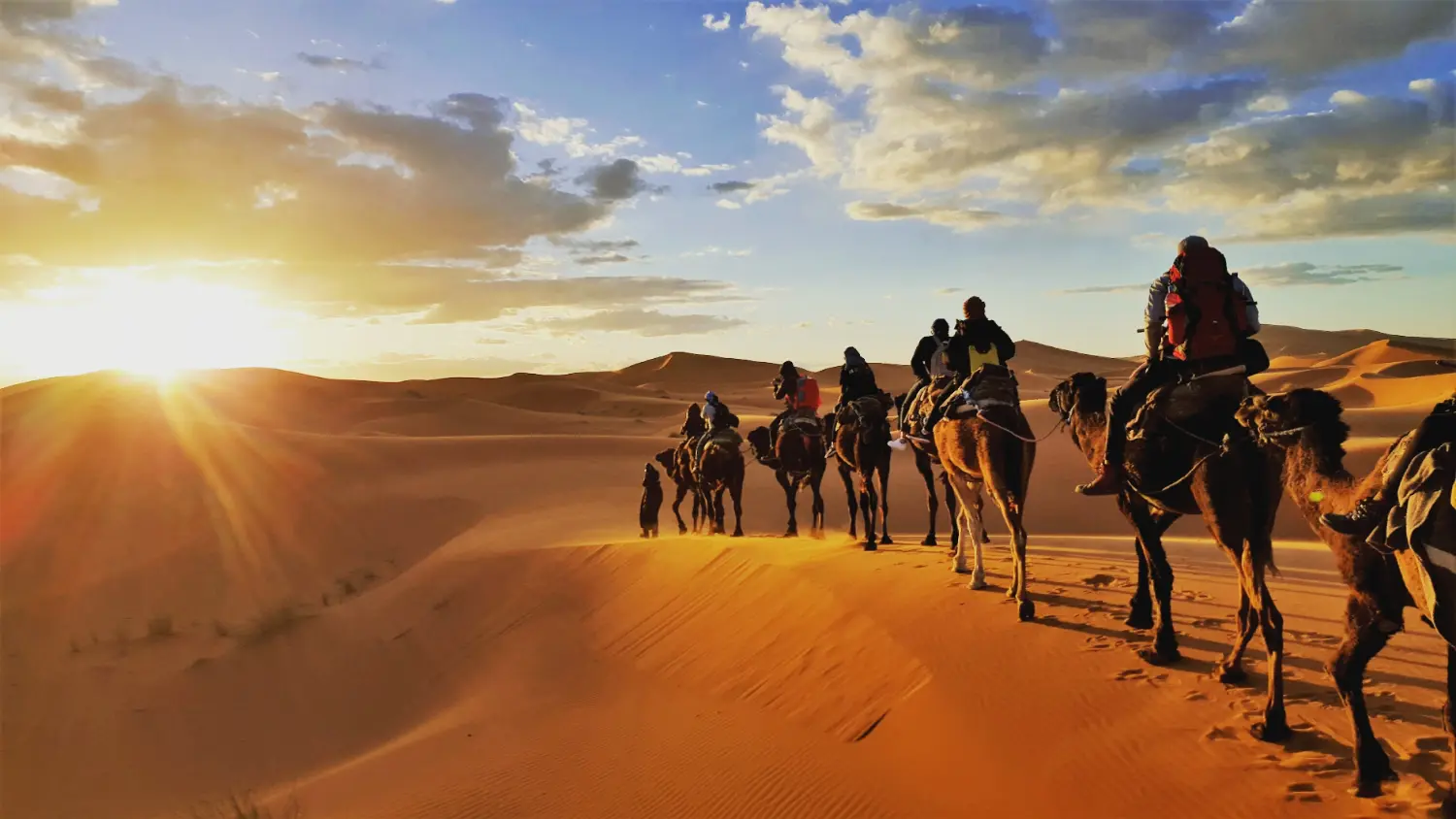
There is no SlaveVoyages for the Sahara. The Atlantic trade produced shipping registers, insurance policies, customs records and manifests, which is why 36,000 individual voyages can be reconstructed. The trans-Saharan trade produced almost nothing comparable. As Sebastian Prange puts it, “business records and correspondence… are entirely lacking for the trans-Saharan trade,” and the sources are “characterized by a singular absence of information on costs, commissions, and profits.”60 Klas Rönnbäck: “numbers for the 650–1400 period can only be guessed at.”61 Nathan Nunn — the economist whose regressions have propagated these figures more widely than anyone’s — says of his own inputs that “the final estimates for the Saharan slave trade are very poor.”62
Four structural reasons: no registers; a duration of about 1,250 years, so small differences in assumed annual averages compound enormously; most nineteenth-century observation coming from British abolitionist consuls with an institutional interest in high numbers; and caravan mortality that is guessed at, so export and arrival figures diverge sharply. Anyone quoting a precise total for these trades is quoting a model.
Trans-Saharan
The two standard series are Ralph Austen’s and Paul Lovejoy’s. Austen gives about 5.15 million for 1300–1880; Lovejoy gives about 7.42 million for 650–1900.63 Most of the gap is not disagreement — it is start date. Austen begins in 1300; Lovejoy begins in 650, and those pre-1400 rows supply roughly half his total while resting on almost no documentary base. Raymond Mauny put it as high as 10.6 million; Rönnbäck and Nunn, taking all three non-Atlantic trades together, land nearer 5 to 6 million — though Rönnbäck’s figure covers the sixteenth to nineteenth centuries only, so it is not directly comparable to Lovejoy’s 650–1900 span. Austen himself revised his figures for arrivals in the Maghrib specifically downward — 683,000 for 1700–1800 and 580,990 for 1800–1880 — to account for desert-crossing mortality and for captives retained elsewhere along the routes. Exports are not arrivals, and the two revisions are not on a like-for-like basis.
One qualitative contrast is well established and important: the Atlantic trade ran roughly two-thirds male, with about a quarter of all captives recorded as children, while the Saharan, Red Sea and Indian Ocean trades ran the other way, with demand concentrated on women and girls for domestic labour and concubinage.64 The hard ratios are thinner than the generalisation implies — nineteenth-century trading-post registers from southern Morocco show 15 women to 3 men across nineteen transactions at Iligh, but near parity at Bairouk — so treat “two women for every man” as a directional consensus rather than a measurement.65 Castration of male captives to produce eunuchs was practised, with very high mortality, which is a large part of why these trades left a smaller demographic footprint in receiving societies than volume alone would predict.
The Indian Ocean and Zanzibar
Red Sea and East African exports between 800 and 1896 are estimated at roughly 3.26 to 4.04 million.66 The chronology is the interesting part: perhaps two-thirds of everyone trafficked across the Indian Ocean moved in the nineteenth century.67 This trade peaked as the Atlantic trade was being suppressed. Whatever ended the Atlantic system, it did not end the global one.
Zanzibar is the case study. Sayyid Said moved his court there in the 1830s–40s and built a clove economy on enslaved labour; by the 1850s roughly two-thirds of the island’s population is estimated to have been enslaved.68 Suppression came in stages under British pressure: the Moresby Treaty of 1822, the Hamerton Treaty of 1845, and then the Frere Treaty of 1873, under which Sultan Barghash prohibited the seaborne transport of slaves and closed the Zanzibar market. Legal abolition of the status came in 1897 under Sultan Hamoud — and it freed nobody automatically. Freedom had to be claimed through a court, and 12,000 people applied between 1897 and 1909. Concubinage was not brought within the abolition until 1909, a deliberate twelve-year carve-out.69
How badly was this counted? Estimates of the number of people legally held in Zanzibar at the moment of the 1897 decree “varied between 7,000 and 70,000.”70 That is a tenfold spread, inside a single peer-reviewed article, about the population being emancipated, at the moment of emancipation. Keep it in mind the next time someone hands you a confident historical number.
One figure worth naming for the complication it causes: Tippu Tip — Hamed bin Muhammed el-Murjebi, born 1837 — the dominant Zanzibari-Swahili ivory and slave trader of the eastern Congo, who by the late 1860s was leading caravans of four thousand men. In February 1887 he was appointed governor of Stanley Falls district for the Congo Free State.71 Leopold II’s regime, which justified itself to Europe as an anti-slavery mission, put the region’s most successful slave trader on its payroll as an administrator.
The Ottomans: the child levy and the Crimean raids
The devshirme conscripted Christian boys from the Ottoman Balkans and Anatolia into the sultan’s service — the levy rate given as one boy per forty households, taken every four to seven years, aged between seven and twenty, first documented in writing in 1438.72 The Janissary corps stood at around 30,000 under Suleiman and 50,000 by the 1650s. The system decayed from the late sixteenth century — a 1666 recruitment target for the central and western Balkans of only 300 to 320; in 1687, just 130 inductees graduated — and was formally ended somewhere between 1638 and the early reign of Ahmet III.
Whether devshirme is properly called slavery is genuinely disputed and I am not going to resolve it here. Recruits were legally kul, servants of the sultan, and could rise to grand vizier; Ottomanists often resist the chattel framing, while Balkan national historiographies treat it as a defining atrocity — the “blood tax,” Greek paidomazoma. Both readings are describing the same practice: children taken from their parents by state compulsion, converted, and never returned. No reliable cumulative total exists; figures of 200,000 to 500,000 circulate without support, and I am not publishing one.
Further north, the Crimean Khanate and the Nogai raided the East Slavic lands for captives on a scale that depopulated regions. Bohdan Baranowski estimated up to a million people taken from the Polish–Lithuanian Commonwealth between 1474 and 1694; Mikhail Khodarkovsky puts 150,000–200,000 from Muscovy in the first half of the seventeenth century alone; Orest Subtelny counts 86 raids between 1450 and 1586 and 70 more between 1600 and 1647, averaging around 3,000 captives each and reaching 30,000 in a single raid.73 In the 1570s close to 20,000 people a year went on sale at Caffa, which occasionally held as many as 30,000 at once. These estimates overlap in geography and period and must not be added together. The scale is nonetheless not seriously disputed: eastern Europe was a captive-export region for two and a half centuries.
The Ottoman Empire never issued a general abolition of slavery as an institution. It issued successive, geographically limited, largely unenforced prohibitions on the trade — a firman in 1830 freeing certain Christian captives, the closure of the Istanbul market in 1847, prohibition of the Circassian and Georgian trade in 1854–55, and the 1857 firman of Abdülmecid I banning the import of African slaves, issued under British pressure, with the Hejaz explicitly exempted because the earlier prohibition had provoked rebellion there. The 1857 firman was never enforced in practice.74 Slavery persisted in Ottoman lands to the end of the empire in 1922.
The Barbary corsairs — handled properly
This is the single most weaponised topic in this entire article, so let me be careful in both directions.
The raiding was real, large and long-running. Corsairs from Tunis, Algiers, Salé and Tripoli took captives from Italy, Spain, France, the British Isles and further. On 20 June 1631, a raiding party under Murad Reis the Younger — Jan Janszoon of Haarlem, a Dutch convert — sacked the village of Baltimore in West Cork and carried off 107 people: 20 men, 33 women and 54 children and youths. Two women, Joan Broadbroke and Ellen Hawkins, are confirmed ransomed after fifteen years. Most of the rest died, converted, or vanish from the record. The village was substantially abandoned.75 In the summer of 1627, corsairs raided Iceland twice — the Tyrkjaránið, the Turkish Abductions — striking the southwest in late June and the southeast and the Westman Islands about a fortnight later, and taking over 400 Icelanders. About ten per cent were successfully ransomed, through protracted Danish negotiations hampered by Denmark having no relations with the North African ports.76
Now the number everyone quotes. Robert C. Davis, in Christian Slaves, Muslim Masters (2003), estimated 1 million to 1.25 million European captives taken to North Africa between 1530 and 1780.77 His method, which he describes candidly, was to work backwards from population stability: identify recorded slave populations at particular places and times, then calculate the replacement rate needed to hold those numbers steady against death, escape, ransom and conversion. He concluded about a quarter of the enslaved had to be replaced each year, implying roughly 8,500 new captures annually at peak. His own caveat: “It is not the best way to make population estimates, but it is the only way with the limited records available.”
The criticism is substantial and belongs in the same paragraph as the figure. Earle — the historian of the Malta and Barbary corsairs — told the Guardian in 2004 that “his figures sound a bit dodgy and I think he may be exaggerating,” the substantive objection being that Davis extrapolated from 1580–1680, the most intense slaving period, across a much longer span.78 Ehud Toledano, reviewing in the Journal of African History, faulted Davis for relying exclusively on European documents without consulting Ottoman sources — a different objection from Earle’s arithmetic one, and both should be cited. John Wright cautions that all modern estimates in this field are back-calculations from human observation. On the other side, the economic historian Ian Blanchard defended Davis, saying he did not find “that absolute figure of one-million at all surprising.” The criticism is not unanimous either.
A useful independent benchmark, though one I flag as reported rather than verified at source: contemporary observers are said to have put roughly 35,000 European slaves across the Barbary coast at any given time in the seventeenth century, with more than 30,000 in Algiers alone by 1650.79 A standing population of 35,000 is compatible with Davis’s cumulative total only under his high 25 per cent annual replacement assumption — which is precisely what Earle disputes. That is where the argument actually turns, and laying it out lets you judge it yourself rather than picking a team.
“Barbary corsairs enslaved more Europeans than Africans were taken to America.”
False as normally stated, by roughly an order of magnitude — and the reason it feels true is worth naming. Against the Atlantic trade as a whole, the comparison fails outright: 1–1.25 million against 12.5 million embarked and 10.7 million disembarked. That is a factor of about ten, using Davis’s own high-end figure.
But Davis made a narrower version of the comparison himself, and readers deserve to know that. His claim was that “from 1500 to 1650… more white Christian slaves were probably taken to Barbary than black African slaves to the Americas” — bounded to a 150-year window, and hedged with “probably.” For that window the Atlantic trade had moved roughly a million people, so the bounded claim is at least arguable. It is also the version that never survives contact with the internet: both qualifications are routinely stripped off before the sentence is quoted.
The version that “works” quietly changes the comparison set. Against direct arrivals in mainland North America — under 4 per cent of the Atlantic total — Davis’s estimate is indeed larger. That is a true statement about two different quantities: the entire Atlantic trade versus one destination’s direct arrivals. It is almost never stated that way.
Structural differences also matter and cut both ways. Barbary captives were frequently ransomed — whole religious orders, the Trinitarians and Mercedarians, existed for the purpose — conversion altered status, and the system was not organised around heritable racial status. Male captives who did not return were often castrated, which is why no self-reproducing descendant population resulted. None of that makes it not slavery. It makes it a different institution with a different arithmetic, which is the only honest way to compare two things.
How much do the experts actually disagree?
Published scholarly estimates for the major slave trades and populations, drawn as ranges. The width of each bar is the argument.
7. Africa: the hardest section to write honestly
Two claims are both true and are constantly used to cancel each other out. They don’t.
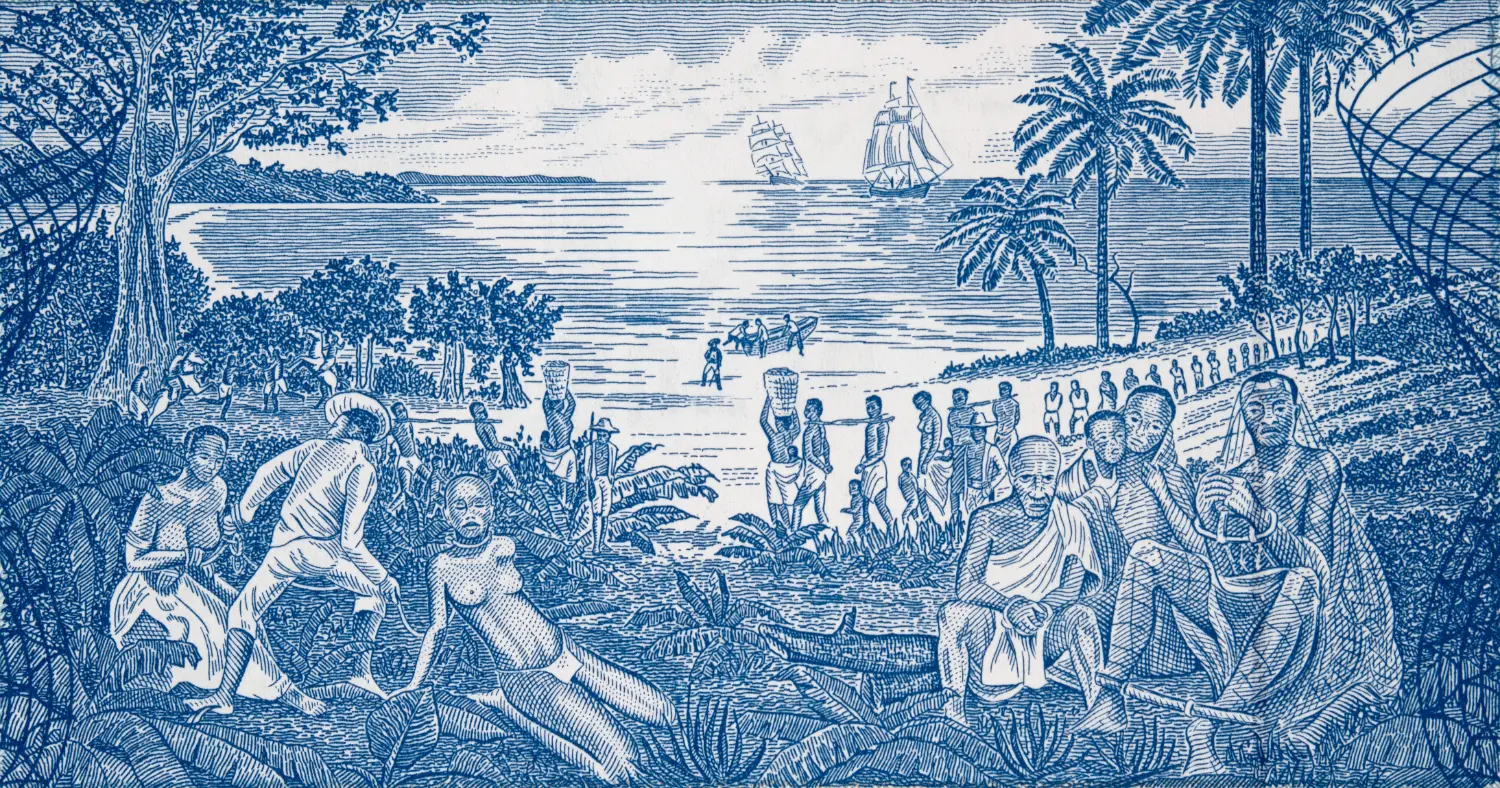
Claim one: slavery existed across West and Central Africa before Europeans arrived, some African states organised warfare around captive-taking and grew rich on it, and European traders overwhelmingly bought rather than raided. Claim two: the demand, the capital, the shipping, the insurance, the plantations and the profits were European, and the trade at Atlantic scale did not and could not exist before that demand did. Both are supported. Neither cancels the other. What follows is an attempt to hold both at once.
Internal African slavery: the Sokoto case
The best-verified figure in African slavery scholarship comes from Paul Lovejoy on the Sokoto Caliphate: two to three million enslaved people by the 1860s, constituting “at least a quarter of the total population and perhaps as much as half,” and still numbering several million at the time of colonial conquest in 1897–1903.80 Lovejoy’s own comparative phrasing is precise and I am going to quote it exactly, because the internet routinely inflates it: the Caliphate’s enslaved population was “on the same order as the United States and Brazil and much larger than Cuba.” He does not say larger than the United States. Anyone who tells you Sokoto held more slaves than the American South is overstating a real scholar’s real finding.
Elsewhere the numbers thin out fast. Boniface Obichere’s study of Asante and Dahomey states plainly that “hard statistical data is difficult to come by if not non-existent,” and the single quantitative datum he offers is roughly 25,000 war captives labouring in the Lake Bosomtwi region of Asante by 1820.81 What he can establish is character: the majority of enslaved people in both states worked in domestic service; others served militarily, on royal plantations — notably Dahomean palm oil — and in skilled crafts. Manumission and absorption into free lineages were common. In Dahomey, children born to free men and enslaved women were automatically free. Asante maintained a specific category, akyere, designated for ritual sacrifice at chiefly funerals; Dahomey practised human sacrifice but kept no equivalent category. Obichere reads this slavery as primarily social and political rather than economic — a position that sits in real tension with Lovejoy’s evidence for productive plantation slavery and with Robin Law’s work on Dahomean palm-oil estates. Present both; the field does.
African elites in the Atlantic trade
John Thornton’s Africa and Africans in the Making of the Atlantic World is the standard statement of African agency: Europeans generally purchased captives taken in warfare between African states rather than raiding for them; peaceful trade became the norm on African coasts by around 1494; African states set the terms of coastal commerce and Europeans held factories, not territory, until the nineteenth century.82
A specific number is usually attached to that finding — that roughly 90 per cent of those shipped across the Atlantic were enslaved by Africans and sold on to European traders — and it is conventionally credited to Thornton and Linda Heywood. I could not verify it at page level in any accessible edition, so by the same rule that keeps the Gezo quotation out of this article, it is not used as evidence here. Treat it as a widely circulated attribution rather than an established statistic. The qualitative finding underneath it does not depend on the number and is not in dispute: Europeans overwhelmingly bought rather than raided.
The institutional detail is well documented. The Aro Confederacy, a merchant network without a centralised state, drove the expansion of the Bight of Biafra trade: 182,066 people embarked from Biafran ports between 1750 and 1800, making the Bight of Biafra the third most important supply region after West Central Africa and the Bight of Benin, and by the mid-nineteenth century the Aro had over 150 trading settlements inland. (A percentage-of-all-departures figure is often quoted alongside that count; the two do not reconcile against any single denominator, so it is left out.)83 At Old Calabar, the Efik trader Antera Duke kept a diary in trade English between 1785 and 1788 documenting an African–British slave-trading network in which he was a principal, not an intermediary — recording commercial disputes with British captains over fee structures and the practice of “pawning,” human beings pledged as collateral against trade credit.84 That is sophisticated commercial agency and pretending otherwise is condescension.
Now the other half, which is equally documented.
The phrase “Africans sold their own people” imports a category that did not exist. Pre-colonial African political identity was ethnic, lineage-based and political, not continental. A Fon captive-taker selling an Igbo captive was not, by any category available to him, selling “his own people” — any more than a Genoese selling a Circassian at Caffa was. The racial category that makes the sentence feel damning was substantially forged by the Atlantic system and its diaspora, not before it.
The gun-slave dynamic was structurally coercive. Warren Whatley’s econometric work finds gunpowder imports and slave exports co-integrated in a long-run equilibrium, with a log correlation around 0.80 — guns and captives moved together, tightly, over the whole period. British gun exports to West Africa rose roughly tenfold, from about 20,000 a year in the 1680s to around 200,000 a year by the 1780s. Whatley’s conclusion is the one that matters: states that abstained “found themselves on the losing side of an arms race.”85 “Nobody forced them” is not a serious description of that equilibrium.
Africans resisted the trade at every level. Sylviane Diouf’s edited volume Fighting the Slave Trade catalogues defensive, protective and offensive West African strategies against it.86 Named rulers protested: Afonso I of Kongo wrote to João III of Portugal in 1526 about the depopulating effect of Portuguese slaving on his kingdom.87 That letter also needs its complication stated: Afonso was himself a participant in and beneficiary of slave exports, and his objection was to unregulated Portuguese slaving and to the enslavement of his own free subjects and nobles, not to slaving as such. Flattening that in either direction is propaganda.
African rulers also resisted abolition, and the documentation is excellent. King Gezo of Dahomey (r. 1818–1858) held out against a decade of British missions, a naval blockade and a treaty. He signed a treaty of friendship and commerce with Lieutenant-Governor Winniett on 3 April 1847 but refused the anti-slave-trade provisions; refused abolition again to Consul Beecroft’s embassy in 1850; and when Palmerston ordered a blockade in September 1851, accepted only a limited treaty on 13 January 1852, rejecting the standard form’s clauses on ending human sacrifice, protecting missionaries, expelling slave traders and British enforcement powers. The blockade was lifted in June 1852 once London accepted the limited version. The last transatlantic slave shipment from Dahomey left in 1863.88 Whether Gezo’s resistance was ideological or a rational judgement that palm oil could not replace slave revenue fast enough is genuinely contested by historians.
There is a much-circulated quotation attributed to Gezo — “The slave trade is the ruling principle of my people. It is the source and the glory of their wealth…” — conventionally traced to Frederick E. Forbes, Dahomey and the Dahomans (1851). It appears in an enormous number of online arguments. I was unable to confirm its wording, volume or page in any accessible edition of Forbes, and Robin Law’s authoritative documentary edition of the British missions to Gezo does not carry that phrasing where I read it. It may well be genuine. Until someone can give a page, it should not be used as evidence, and it is not used here. This is what sourcing discipline costs, and it is cheaper than being wrong in public.
The synthesis I would defend: local bargaining power was real and should not be denied. Structural control over the Atlantic system was not African — Anne Bailey’s critique of Thornton is precise on this, that African elites held continental power but not intercontinental power over capital, shipping, insurance and plantations.89 Participation was concentrated in specific coastal states and merchant elites, not general. And Lovejoy’s central thesis — the reason his book is called Transformations in Slavery — is that the external trade did not merely tap an existing African institution but reshaped it into something far more extractive, and that internal African slavery expanded in the nineteenth century as Atlantic exports were suppressed.90
Which is the pattern this whole article keeps running into. Slavery was everywhere. What the Atlantic economy did was industrialise it.
8. The Indigenous Americas, before and after
This section is easy to misuse, so here is the frame up front: every specialist cited below insists these systems were structurally different from Atlantic chattel slavery, and several of them show colonial demand transforming those systems into something far more lethal. The transformation is the story. The comparison is not a defence of anything.
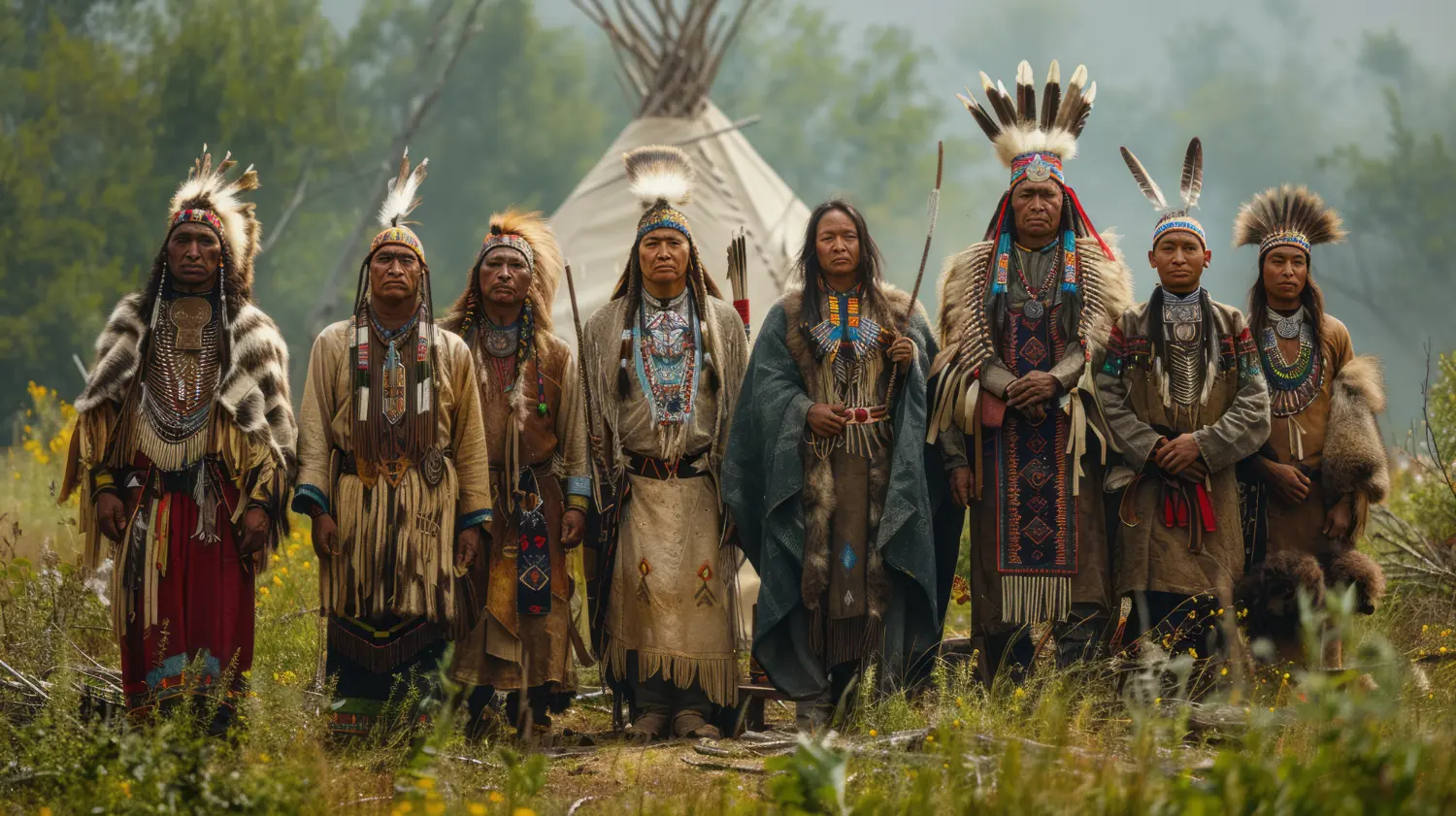
The Northwest Coast
The peoples of the Pacific Northwest — Tlingit, Haida, Tsimshian, Nuu-chah-nulth, Chinook and others — ran slaveholding societies substantial enough that Leland Donald’s standard study argues some communities “possessed enough slaves to merit consideration as large-scale slave systems,” with slavery “central to these hunting-fishing-gathering societies” economically and ritually.91 Two trading networks operated: a northern one linking Tlingit, Haida, Tsimshian and Heiltsuk, and a Columbia River network to the south.
The village-level proportions are striking. Donald Mitchell’s demographic profile puts it at up to a quarter of the coast-wide population at any given time. Among the Makah at Cape Flattery, 20–40 per cent of a village’s population “at many places.” James Douglas’s 1853 census gives roughly 25–30 per cent for the Mowachaht at Nootka Sound. Yvonne Hajda’s work on the Lower Columbia records Fort George village under Concomly at 47 per cent enslaved and Kiesno’s village at 31 per cent. Maquinna held perhaps fifty slaves; Haida chiefs typically ten to twelve; most titleholders two or three.92 David Graeber and David Wengrow note these proportions “rival what could be found on the cotton plantations of the colonial South and are in line with estimates for household slavery in classical Athens.”93
First, the source criticism is serious. Christon Archer, reviewing Donald in BC Studies, objected that the quantitative analysis rests on data of “low confidence” that “cannot be taken as conclusive”; that Donald’s use of primary sources is “cursory and uncritical”; and that he revives discredited fur-trader accounts without new evidence. Archer also raises the practical question of how so many enslaved people could have been controlled during seasonal migration.94
Second, and more important: nearly every number above comes from fur-trade-era observation, roughly 1780–1880. That is after contact, during a period Donald himself treats as one of significant change. Presenting these as pre-contact proportions would be wrong, and the maritime fur trade’s arrival is itself a plausible driver of the numbers being observed.
The Comanche
Pekka Hämäläinen’s The Comanche Empire (2008) argues Comanches ran an expansionist power that pulled Europeans and other Native groups into interaction spheres organised around trade in goods and captives.95 I am not going to attach a captive-proportion figure to Hämäläinen, because the number that circulates online is not one I can find in him, and because his population estimates are themselves under sustained attack — Joaquín Rivaya-Martínez rejects them as “overinflated” (Hämäläinen’s roughly 40,000 around 1780 against Rivaya-Martínez’s archivally grounded 12,000–14,000) and in 2023 called the Comanche-empire hypothesis a “historiographic mirage.”96
Use Rivaya-Martínez instead, because his figures are archival and explicit. Analysing more than 800 individuals captured by Comanches between 1820 and 1875, he finds that over 61 per cent of captives were children aged five to twelve; that over 66 per cent were male; that boys aged five to twelve alone were over 46 per cent of abductees; and that by the 1900s, captives and people of captive descent amounted to over 40 per cent of the Comanche population.97
And here is the crucial nuance, which is the whole reason this section needs care. Comanches incorporated captives by adoption — young children taken in by childless families — by marriage, and by co-optation as equals. They enslaved older captives they did not adopt, designating them tʍrʍʔaiwapɨ: forced labour, corporal punishment, no inherent rights. But that enslavement was “neither hereditary nor necessarily permanent.” That single clause is the difference between this institution and the one being built simultaneously in Virginia.
Mesoamerica and the Haudenosaunee
Aztec tlacotin status was not hereditary — children of enslaved people were born free. The enslaved could marry, have free children, and own property. The principal route in was self-sale during famine; spouses could sell each other and parents could sell children, with the possibility of redemption by repaying the price; a change of status had to be formally witnessed by four officials. In the marketplace, those for sale wore wooden or metal collars to prevent escape.98 No reliable estimate of the tlacotin share of the population exists, and tlacotin were a distinct category from war captives destined for sacrifice — conflating the two is a common error.
Haudenosaunee mourning wars operated on a different logic again: captives were taken to fill the social positions of the dead and restore spiritual power lost to the community, with bereaved matrons deciding whether a given captive was adopted into the household or subjected to ritual torture and execution. By the mid-1660s, Jesuit missionaries estimated that two-thirds or more of the people in many Iroquois villages were adoptees; in 1657 Paul Le Jeune believed there were “more Foreigners than natives of the country” in Iroquoia.99 That figure is a contemporary impression, not a count, and should always be attributed as such. The mechanism behind it is the important part: European epidemics had halved Iroquois populations by the 1640s, converting sporadic, targeted mourning wars into constant, desperate campaigns for ever more captives. The colonial encounter did not create the institution. It put it under a pressure it was never designed to bear.
The other slavery
And then colonists enslaved Indigenous people, on a scale most people have never heard a number for. Andrés Reséndez’s The Other Slavery — Bancroft Prize, 2017 — estimates between 2.5 and 5 million Indigenous people enslaved across the Americas, from Columbus’s arrival through the early twentieth century, and argues that enslavement, not epidemics alone, was primarily responsible for Indigenous population collapse, through a synergistic relationship between the conditions of enslavement and disease mortality.100 The range is very wide, and it has to be: much of this enslavement was formally illegal and left no paper trail. Brett Rushforth’s independent estimate is 2 to 4 million, with the striking observation that through roughly 1680–1690 there had been more enslaved Indians than enslaved Africans in the Americas.101
The English colonial case is documented tightly. Alan Gallay’s work on the Carolina trade finds between 30,000 and 51,000 Indians enslaved by the English in the American South between 1670 and 1715 — and, the single most quotable fact in the field, that between 1670 and 1715 more Indians were exported into slavery through Charles Town than Africans were imported.102 Destinations included Virginia, New England and the Caribbean. In some colonial regions American Indians made up as much as 25 per cent of the enslaved population.
The Spanish systems ran in parallel: encomienda, formalised in 1503, a crown grant of a specified number of Indios in exchange for nominal protection and Christian instruction, which “in practice became a form of enslavement”; and repartimiento, operating as early as 1499 and formalised around 1575, called mita in Peru and cuatequil in New Spain, conscripting an initial 5 per cent of an Indigenous community for mining and 10 per cent for seasonal agriculture — and, after the reforms of 1601–1609, requiring 25 per cent of the Indigenous population to work for Spaniards.103 New grants of encomienda were prohibited in 1721; the system was officially abolished in the late eighteenth century.
9. The Atlantic system: what actually made it different
Having spent seven sections establishing that slavery was universal, this is the section where I explain why the Atlantic version is not just one more entry on the list.
Start with what is not the answer. It is not scale alone — the Saharan and Indian Ocean trades together moved comparable numbers over a longer span. It is not cruelty — the Spartan krypteia and Caffa’s galleys will hold their own against anything. It is not that other people didn’t do it — they did, on every continent.
Four things made it structurally distinct, and all four are legal rather than moral facts.
1. Heritability through the mother
In December 1662 the Virginia General Assembly passed a statute that is, more than any other single document, the hinge of the Atlantic world:
“WHEREAS some doubts have arrisen whether children got by any Englishman upon a negro woman should be slave or ffree, Be it therefore enacted and declared by this present grand assembly, that all children borne in this country shalbe held bond or free only according to the condition of the mother…” Hening, Statutes at Large, 2:170, December 1662104
Partus sequitur ventrem — the offspring follows the belly. Jennifer Morgan’s analysis shows this was not a straightforward borrowing from Roman law: English common law and bastardy codes would have assigned paternal responsibility. Virginia’s legislators instead reached for property law — the principle that if a man sows on another’s land the produce belongs to the owner — converting a question of sexual morality into one of commodity ownership.105
The consequences compound. It makes slavery self-perpetuating without importation. It forecloses kinship as a route out. It makes the rape of an enslaved woman by her owner a profitable act. And it makes reproduction an asset class, which is why, after 1808, the American domestic slave trade became economically central.
2. A racial basis
Roman slavery was explicitly non-racial: enslavement came from warfare, piracy, kidnapping and child abandonment, and “people of any race, ethnicity, or place of origin might become slaves, including freeborn Romans.”106 Atlantic slavery mapped bondage onto a hereditary phenotypic category. This is why emancipation did not end the caste: when the legal status is abolished, the marker of the status remains visible on every descendant, and the social machinery built to justify the status keeps running without it. No other major slave system had that property, and it is the single best explanation for why the aftermath in the Americas looks the way it does and the aftermath in, say, Korea does not.
3. The manumission pathways were closed
Rome had three ratified mechanisms plus informal manumission, and the freed libertus got citizenship and a vote, with disabilities that did not pass to his sons. Islamic law built in exits: mukātaba, contracted self-purchase; the umm al-walad, a concubine bearing her master’s acknowledged child, who could not be sold and was freed at his death, her child free; manumission as an act of piety; and military slaves rising through the ranks, with Mamluks ruling Egypt from 1250 to 1517 and janissaries reaching the grand vizierate. Spanish America had coartación, self-purchase in instalments, formalised in the Código Negro of 1789, producing large free populations of colour.107
Against that: Virginia in 1723 forbade manumission “except for some meritorious services to be adjudged and allowed by the governor and council.” South Carolina required a special act of the legislature. Florida prohibited it outright. By the 1850s most Southern states had made manumission all but impossible. A slave system with exits produces a free population of the same descent; a system without them produces a permanent caste. That was a policy choice, made repeatedly, by legislatures.
4. Legal personhood as property, demonstrated
The cleanest single illustration is the Zong. On 29 November 1781 the crew of the slave ship Zong threw more than 130 enslaved Africans into the sea, reportedly to conserve fresh water. The litigation that followed — Gregson v Gilbert — was an insurance dispute. The owners sued the underwriters for the value of the cargo.108 That is what chattel status means, expressed in the only language a court could hear. Granville Sharp pursued the case; Olaudah Equiano is credited with bringing it to his attention; it became a rallying point for abolition and, sixty years later, Turner’s Slave Ship.
Now the numbers — and the surprise
That last figure is the one that stops arguments in both directions, so let me give it precisely and with its ambiguity intact. The editors of the Trans-Atlantic Slave Trade Database state that “the Caribbean and South America received 95 percent of the slaves arriving in the Americas” and that “less than 4 percent disembarked in North America, and only just over 10,000 in Europe.”109 David Eltis’s overview essay on the same site says the United States “absorbed only 5 percent of the slaves arriving in the Americas.”110 The two figures are probably measuring slightly different things — direct trans-Atlantic arrivals in North America versus captives who eventually reached the United States including those transshipped from the Caribbean — but I could not find a source that says so, so I am giving you both, with both wordings, rather than harmonising them myself. Brazil alone took roughly 40 per cent of everyone embarked — about 45 per cent of everyone who arrived alive; Brazil and the British Americas together took more than seven of every ten captives. Watch that denominator: a great many arguments about this trade are conducted with one side using embarkations and the other using arrivals.111
Who carried them
Africans embarked on trans-Atlantic slaving voyages by national carrier, 1501–1875. These are the database’s own figures, and they are exact because 36,000 voyages left records.
Where they were taken — and where the enslaved population ended up
Left: share of Atlantic arrivals by destination region. Right: enslaved population of the same regions at the point each abolished slavery. The two do not match, and the mismatch is the point.
The demographic paradox
Fewer than 400,000 people arrived directly in mainland North America. By 1860 the enslaved population of the American South was 3,950,511.112 A tenfold increase, almost entirely by natural increase — and growth that continued undiminished after the external trade closed in 1808.
No other major New World slave society did this as a whole — though, as below, non-sugar regions within Brazil did. The Caribbean and Brazilian sugar regimes consumed lives faster than they reproduced them and required constant resupply. The pivotal scholarly treatment is Michael Tadman’s “The Demographic Cost of Sugar” (American Historical Review, 2000), which argues the decisive variable was the crop, not national character or slaveholder benevolence: heavy sugar regimes produced sustained net natural decrease, while non-sugar regimes — the US South, and non-sugar zones within Brazil — produced increase.113 The mechanisms generally cited are gang labour and mill-season mortality, heavily male-skewed cargoes, suppressed fertility, the disease environment, and planters’ calculation that buying replacements was cheaper than rearing children while the trade stayed open.
Nineteenth-century apologists cited American natural increase as evidence of benign treatment. It is nothing of the kind — it is a fact about crop mix, climate, disease environment, earlier creolisation and a more balanced sex ratio. And the corollary is grim rather than comforting: it is precisely what made the internal trade economically central after 1808. Roughly a million people were forcibly relocated from the Upper South to the Deep South — nearly 250,000 across state lines in the 1830s alone, over 193,000 in the 1850s — a forced migration more than twice the size of direct Atlantic arrivals to the same territory.114 Growth by reproduction is not gentleness. It is a different business model.
10. Canada’s blind spot
Two facts most Canadians have never encountered: the majority of enslaved people in New France were Indigenous, not Black; and the famous 1793 anti-slavery Act freed nobody who was already enslaved.

Slavery existed in what is now Canada for roughly two centuries, and it was legal. On 13 April 1709, Intendant Jacques Raudot formalised what had been informal practice by ordinance: “Tous les Panis et nègres qui ont été achetés… appartiendront en pleine propriété à ceux qui les ont achetés comme étant leurs esclaves” — all Panis and Negroes who have been purchased, or will be, belong in full property to those who have purchased them, as their slaves.115
“Panis” derives from Pawnee, among the earliest important suppliers of Indigenous captives, and became the generic French term for any enslaved Indigenous person — drawn from Plains Apache villages in the southwestern Plains, Sioux settlements in present-day Minnesota, Fox and Sauk communities near the Great Lakes.116
Marcel Trudel’s exhaustive archival work documented 4,185 enslaved people in New France and later Upper and Lower Canada: 2,683 Indigenous, 1,443 Black, 59 of unknown origin.117 Roughly two-thirds Indigenous. That is a documented floor rather than a population — Trudel found about 3,000 in Catholic parish registers and roughly a thousand more only in lacunary records — and Brett Rushforth estimates the true figure much higher, suggesting colonists in New France held “thousands of American Indians as slaves, perhaps as many as ten thousand over the course of the century.”118 Give both, and say which is which.
The demographic profile is the detail that lands hardest. The average age of enslaved Panis was fourteen; of enslaved Black people, eighteen. Fifty-seven per cent of enslaved Indigenous people were girls or young women; 57 per cent of enslaved Black people were male. In Louisiana, the average age at death for enslaved Indigenous people was seventeen.119
Rushforth’s analytical contribution matters here too, because it prevents the story from being a simple one. Indigenous nations used captive-giving as diplomacy — captive enemies given as gifts to create or affirm alliances — and used it to steer French colonial expansion, blocking a French–Sioux alliance for decades. French demand then fused that practice to Atlantic slaving, and Martinique’s difficulty obtaining African captives during the Saint-Domingue sugar boom “facilitated slaving raids on the Great Plains.” A Caribbean sugar shortage produced raids in what is now Manitoba.
Chloe Cooley, and what the 1793 Act really did
On 14 March 1793, at Queenston in Upper Canada, Sergeant Adam Vrooman bound an enslaved Black woman named Chloe Cooley with rope, put her in a boat and took her across the Niagara River to sell her in the United States, assisted by his brother and another man. She fought and screamed for help. It did not save her.120
On 21 March, Peter Martin — a Black Loyalist and army veteran — and William Grisley, a white labourer who had worked for Vrooman, reported the incident to the Executive Council. Lieutenant Governor John Graves Simcoe, Chief Justice William Osgoode and Peter Russell directed Attorney General John White to prosecute. The charges were dropped, because what Vrooman had done was legal.
Simcoe and White used the case to push abolition legislation. It met opposition from slaveholders inside the government, and what emerged on 9 July 1793 was a compromise: “An Act to prevent the further introduction of slaves.” Here is exactly what it did:
- Banned importation of any Black person into Upper Canada as a slave or indentured servant. Anyone enslaved arriving in the province thereafter was free.
- Freed nobody already enslaved. Existing enslaved people remained the property of their owners for life.
- Children born to enslaved mothers after 1793 remained enslaved until age twenty-five.
It applied only to Upper Canada — not Lower Canada, not Nova Scotia, not New Brunswick.121 It is routinely described in Canadian public memory as “abolishing slavery in Upper Canada.” It was a gradual-abolition importation ban, and it was the first such legislation in the British Empire, and both of those things are true simultaneously.
Actual abolition in Canada came from Westminster: the Slavery Abolition Act 1833, in force 1 August 1834, which ended slavery throughout the British Empire including all of British North America, freeing over 800,000 people empire-wide.122 Afua Cooper frames it as concluding “206 years of enslavement of African people in Canada.” By then relatively few enslaved people remained in Upper Canada, because the 1793 Act had done its slow work — so 1834 matters more legally than demographically there. Cooper adds a demographic note that completes the picture: by the British period, 1760–1834, nearly 100 per cent of the enslaved in Canada were of African descent. The Indigenous majority was a feature of the French regime.
Slavery in Canada was legal from 1709 to 1834. Its victims were majority Indigenous under the French and overwhelmingly African under the British. It was ended not by Canadian moral leadership but by an Act of the British Parliament, forty-one years after a Canadian statute had declined to free a single enslaved person then living. Canada also received over 30,000 people escaping American slavery via the Underground Railroad, and over 3,000 Black Loyalists arrived in Nova Scotia in 1783–85.123 Both halves of that are the country’s history. Only one half is generally taught.
11. Follow the money: who actually profited
This is the section where the argument lives, so it is also the section where I am going to be most careful about what the evidence supports and what it doesn’t.
Ownership was concentrated. Very concentrated.
In 1860, the American South held 3,950,511 enslaved people with an aggregate market value close to $4 billion — larger than the combined value of all US railroads and factories.124 The number of slaveholders was 393,967. Of those, 216,269 — almost 55 per cent — held five people or fewer. 78,726 held exactly one. At the other end, 2,341 held between 100 and 499 people, and 22 held 500 or more. Fewer than 1 per cent of slaveholders owned more than a hundred people.125
Who owned whom: the 1860 slaveholder distribution
Number of slaveholders in the fifteen slave states, by size of holding. The census counted 393,967 in total.
“What share of Southerners owned slaves?” is quoted anywhere from about 5 per cent to over 30 per cent, and all of those numbers can be produced from the same census. The answer depends entirely on three choices: individuals or families as the denominator; all fifteen slave states or only the eleven Confederate ones; and whether household members are counted as part of a slaveholding family.
Per individuals, across all slave states, the figure drops below 6 per cent. Per family, in the eleven Confederate states, it rises above 30 per cent. Jenny Bourne’s summary from the census is: “Less than one-quarter of white Southerners held slaves.”126
Bad-faith argument in both directions lives entirely inside that choice of denominator. Anyone citing “only 5 per cent” to minimise, or “a third of families” to maximise, is picking a denominator and not telling you. The defensible statement is: a minority of Southern whites owned enslaved people — Bourne’s census-derived summary is “less than one-quarter of white Southerners”; family-based denominators run considerably higher and individual-based ones considerably lower; and ownership within that minority was extremely concentrated at the top. I have deliberately not put a single headline percentage on that, because doing so would require picking exactly the denominator this panel is about.
Bacon’s Rebellion: what the evidence supports
Here is the argument you have probably encountered: in 1676, poor whites and enslaved Africans rebelled together in Virginia under Nathaniel Bacon; the planter elite, terrified, wrote racial law to split them; whiteness was invented as a bribe. It is a compelling story. It is also, in that form, defended by no serious specialist, and getting it right is more useful than getting it loud.
What is genuinely established: almost nobody disputes that the Virginia gentry consolidated a racial legal order in the decades around 1676, or that the resulting law had the effect of separating poor whites from enslaved Africans. The statutory ratchet is on the record — 1667, baptism does not confer freedom; 1669, a master who kills a resisting slave is exempt from felony; 1670, free Africans barred from purchasing non-African servants; 1680, slaves barred from carrying weapons, from leaving the plantation without a certificate, from raising a hand against “Christians”; 1691, an act against interracial marriage; 1705, the comprehensive Virginia Slave Code.127
The thesis that 1676 caused this is Edmund Morgan’s, from American Slavery, American Freedom (1975), whose famous line is: “Resentment of an alien race might be more powerful than resentment of an upper class.”128 Theodore Allen and Kathleen Brown developed versions of it, Brown’s running through gender and sexual regulation rather than class-splitting — a genuinely different causal path that is often merged into Morgan’s by people summarising both.
And here is the problem, which the dates hand you for free: 1662, 1667, 1669 and 1670 all precede 1676. Only 1680, 1691 and 1705 follow it. The critics have pressed exactly there. Anthony Parent argues Morgan “focused too exclusively on Bacon’s Rebellion… as the genesis of that contradiction,” proposing instead a longer elite-driven process of land engrossment and labour consolidation from 1660.129 John Coombs argues from probate and headright evidence that Virginia’s elite were converting to enslaved African labour substantially in the 1660s and 1670s, before the rebellion.130 Holly Brewer relocates causation to Stuart imperial policy and metropolitan legal theory — slavery pushed from London, not improvised in Jamestown after a riot.131 James Rice reframes the rebellion as fundamentally about Indian land and frontier policy.132 Morgan is also criticised for functionalism: reading the outcome back as intention without direct evidence that legislators articulated that aim.
Drop “Bacon’s Rebellion invented whiteness.” It is a slogan and it will be dismantled by anyone who knows the dates.
Keep this instead, which is stronger because it is defensible: a colonial elite facing a labouring population it could not control wrote, over roughly forty-five years, a body of law that made race the organising principle of unfreedom — and the effect of that law, whatever the intent, was to give the poorest free white man a legal status he could not lose and an enslaved Black man could never gain. The causal arrow and the timing are disputed. The outcome, and who wrote the statutes, are not.
Who got paid at abolition
This is the part of the record that is hardest to argue with, because it is all accounting.
Britain abolished slavery in its empire in 1833 and paid £20 million in compensation — to slave owners. Not to a single enslaved person. UCL’s Legacies of British Slavery project states the position flatly: “the records we have concern slave-owners; regrettably, we do not have information on the enslaved themselves.”133 The enslaved received instead an “apprenticeship” — four to six further years of unpaid labour as legislated, ended for everyone in 1838 — which is to say they paid part of the price of their own emancipation.
The scale: the £20 million was roughly 40 per cent of the Treasury’s annual expenditure and something on the order of 4.5 per cent of GDP, using contemporary figures of about £51.5 million in government spending and £443 million in GDP for the early 1830s.134 Those two ratios — share of state spending and share of GDP — are routinely conflated in popular writing; they are different measures and both are given here.
Where did it go? Nicholas Draper’s foundational research found that more than half the compensation awarded can be traced to owners or other recipients in Britain — not absentee planters in the colonies but a rentier slave-owning class among the aristocracy, gentry and urban upper-middle classes in Bath, Clifton and Edinburgh, including bankers, financiers, clergy, and widows and single women holding enslaved people in trust.135 UCL’s estimate is that between 10 and 20 per cent of Britain’s wealthy can be identified as having had significant links to slavery. The financing syndicate was led by Nathan Mayer Rothschild and Moses Montefiore. The largest single award went to Sir John Gladstone — father of the future prime minister — £106,769 for 2,508 people across nine plantations.
You have probably seen the claim that British taxpayers only finished paying off the slave-owner compensation loan in 2015. Here is the precise version.
True: HM Treasury’s own announcement of the 2015 redemption of the UK’s undated gilts describes them as “debts first issued in 1752 and subsequently used to finance the Napoleonic and Crimean Wars, the Slavery Abolition Act (1835) and the Irish Distress Loan (1847).” The final tranche — 2¾% and 2½% Annuities, 2½% Consolidated Stock and 2½% Treasury Stock — was redeemed at par on 5 July 2015. 4% Consolidated Loan had gone on 1 February 2015 and 3½% War Loan on 9 March 2015.136
Not true, or at least not what it sounds like: there was no identifiable, ring-fenced “slavery loan” being amortised until 2015. The original 1835 borrowing was consolidated by Gladstone in 1853 and converted by Goschen in 1888 into undated consols — perpetual stock paying a coupon forever until called. What was redeemed in 2015 was a commingled instrument whose lineage includes the compensation borrowing alongside the Napoleonic Wars, Crimea and the Irish famine relief loan. “Taxpayers were still paying off the £20 million” is not the right description of a perpetual bond.
The accurate sentence is: the borrowing raised to compensate British slave owners was folded into perpetual national debt that was not extinguished until 5 July 2015, on the Treasury’s own account of what that debt was for. That is remarkable enough without embellishment.
And the other direction: Haiti
Britain compensated the owners. France compelled the formerly enslaved to compensate their former owners.
On 17 April 1825, under the guns of a French squadron, Charles X’s ordinance demanded 150 million francs from Haiti in exchange for recognition of the independence it had won by force twenty-one years earlier — five annual instalments of 30 million, roughly six times Haiti’s annual revenue. Haiti borrowed from French banks to make the first payment, creating the “double debt.” The indemnity was reduced in 1838 to 90 million over thirty years, nominally ending in 1883. Approximately 112 million francs were actually transferred — more than the reduced principal, because Haiti was servicing the French bank loans it had taken out to make the payments at all. Because of those successor loans, Haiti’s final related payment was made in 1947 — to National City Bank of New York.137
In inflation-adjusted terms the transfers come to roughly US$560 million in 2022 dollars. Estimates of the foregone growth over two centuries, from fifteen economists consulted by the New York Times, range from $21 billion to $115 billion — and that five-fold spread is itself the finding. It is a counterfactual growth model, not an accounting figure. Publish the range; never a point estimate.
Who was compensated at emancipation
Four national abolitions, and where the money went.
Across four different abolitions on three continents, the nineteenth-century state recognised one thing consistently: the property claim, not the person. Owners were compensated in Britain, the Netherlands and the French colonies; the formerly enslaved were compensated nowhere, and in Haiti and Russia were billed. In the United States the only federal compensation ever paid was in the District of Columbia in April 1862 — up to $300 per freed person to Union-loyal former owners, plus up to $100 to each freed person choosing to emigrate. Over the following nine months the commissioners approved 930 petitions covering 2,989 people.138
That is the strongest evidence in this article for the reading that slavery was, at the level of state policy, a property system before it was a race system — because when the states dismantled it, property is what they paid out on. It does not follow that race was epiphenomenal. Section 9 is there precisely because it wasn’t.
12. How it ended, country by country
Five mechanisms, not one: revolution or coup, legislation, war, colonial imposition, and external diplomatic pressure.
Abolition, and what caused it
Selected national abolitions, 1804–1981, coloured by mechanism. Note the ninety-three-year gap between the last abolition in the Americas and the last on earth.
The only case where the enslaved abolished it themselves
The largest slave uprising since Spartacus began in Saint-Domingue on 21 August 1791; 100,000 people joined within weeks. French abolition followed, it did not precede: Léger-Félicité Sonthonax proclaimed abolition in the northern province on 29 August 1793 as an emergency wartime measure, freedom offered to enslaved men who would fight for the Republic; the National Convention decreed general abolition on 4 February 1794. Napoleon sent Leclerc in 1802 with secret instructions to restore slavery once French military dominance was re-established; Guadeloupe was re-enslaved by force, Saint-Domingue was not. Dessalines declared independence at Gonaïves on 1 January 1804.139 France would abolish slavery again, permanently, on 27 April 1848 — and in Martinique it took effect on 23 May, ahead of the decree’s own timetable, because the enslaved rose and forced the governor’s hand.
Britain: the argument that never ended
The Slave Trade Act 1807 received royal assent on 25 March 1807 and took effect 1 May. The Slavery Abolition Act 1833 received assent on 28 August 1833 and came into force 1 August 1834, exempting East India Company territories, Ceylon and St Helena — a gap closed only by the Indian Slavery Act 1843.140
Why did Britain do it? This is one of the genuinely unresolved debates in economic history and I am going to leave it unresolved, because it is.
Eric Williams’s Capitalism and Slavery (1944) advanced two claims: a decline thesis, that abolition followed falling profitability, and a capitalism thesis, that slave-trade profits financed British industrialisation. British publishers refused the book for twenty years. Seymour Drescher’s Econocide (1977) attacked the decline thesis directly: in 1807 the British slave system was expanding and profitable, and abolition was economic suicide driven by moral mobilisation among people who could vote. On the capitalism thesis, Stanley Engerman calculated slave-trade and plantation profits at under 5 per cent of the British economy, and David Richardson at under 1 per cent of domestic investment. On the other side, David Beck Ryden finds evidence of an emerging profitability crisis by the early nineteenth century, and Joseph Inikori challenges the revisionists by widening the frame to whole-Atlantic trade rather than the sugar islands alone.141
The fair summary: Drescher refuted the narrow decline claim about 1807. The profits-financed-industrialisation claim remains genuinely contested. And neither econometric result settles the moral and political question of whether Britain’s humanitarianism was self-interested — which is a different kind of question.
Resistance as cause
The claim that white people ended slavery survives contact with the Baptist War badly. On Christmas Day 1831, up to 60,000 of Jamaica’s roughly 300,000 enslaved people rose under the Baptist deacon Samuel Sharpe — the largest slave revolt in the British Caribbean. Fourteen white people were killed. Over 300 rebels died in the fighting and roughly 310 to 340 were judicially executed afterwards, Sharpe among them. The causal link to 1833 runs through the plantocracy’s reprisals, which extended to white missionaries: when Burchell and Knibb testified to the House of Commons about their treatment, MPs were outraged, and Parliament passed the Abolition Act the following year.142
Add Nat Turner in Southampton County, Virginia, on 21 August 1831 — which precipitated Virginia’s 1831–32 legislative debate on emancipation, and, when that failed, a wave of harsher slave codes. Add the maroon communities that won territorial concessions by force decades or centuries before general emancipation: Palmares in Brazil, reportedly 30,000-plus people at its height, from around 1600 to 1694; the Jamaican Maroon treaties of 1739–40 granting 2,500 acres and freedom nearly a century before abolition; the Ndyuka treaty in Suriname of 10 October 1760.143 Add the Black abolitionists who were central rather than decorative: the Sons of Africa, founded 1787, Britain’s first Black political organisation, whose lobbying via Equiano produced the Slave Trade Act 1788; Quobna Ottobah Cugoano, whose Thoughts and Sentiments (1787) demanded immediate and total emancipation — more radical than most white abolitionists of the day — and argued the enslaved had a duty to escape and a right to use force.
The Royal Navy paradox
From 1808 the West Africa Squadron patrolled to suppress the trade Britain had recently dominated. Over roughly sixty years it seized around 1,600 ships and freed about 150,000 people, intercepting perhaps 6 per cent of transatlantic slave voyages. Almost 1,600 British sailors died on Squadron duty between 1830 and 1865, principally of disease.144 Kaufmann and Pape’s study characterises the campaign as the most expensive international humanitarian intervention in modern history — I have seen a specific percentage-of-national-income figure attached to that in a hundred places, and could not verify it against the article, so it is not here.145
Hold that alongside this: in the decade 1791–1800 alone, British vessels made around 1,340 slaving voyages landing nearly 400,000 people, and Britain’s all-time total was 3,259,441 embarked — the second-largest carrier in history.146 Both facts are true. Britain built the largest slave-trading operation of the eighteenth century, then spent sixty years and 1,600 sailors’ lives suppressing what it had built, and paid £20 million to the owners and nothing to the freed. Any account that keeps only one of those three is propaganda, whichever one it keeps.
The long tail
The dates most people never learn:
| Year | Where | Mechanism | Detail |
|---|---|---|---|
| 1861 | Russia | Decree | Serfdom; 22–23m people; redemption payments not cancelled until 1907 |
| 1863 | Netherlands | Legislation | Suriname and Dutch Caribbean; freed people bound to ten further years’ contracted labour, to 1873 |
| 1865 | United States | War | 13th Amendment ratified 6 December — with the punishment clause intact |
| 1888 | Brazil | Legislation | Lei Áurea, 13 May — last in the Americas; no compensation to anyone |
| 1894 | Korea | External pressure | Gabo Reform abolishes the status system entirely |
| 1897 | Zanzibar | Colonial | Legal status abolished; freedom claimed through courts; concubinage exempt until 1909 |
| 1909–10 | China | External pressure | Nubi category abolished in the Qing criminal code, promulgated 15 May 1910 |
| 1915 | Siam | Legislation | End of a forty-one-year gradual process begun in 1874 |
| 1924 | Sudan | Colonial | Anglo-Egyptian Condominium — a conventional date for a gradual, ordinance-by-ordinance suppression running from 1899; continued unofficially for decades |
| 1942 | Ethiopia | Decree | Haile Selassie, 26 August; the culmination of decrees issued and reissued since 1889 |
| 1952 | Qatar | Decree | |
| 1962 | Saudi Arabia | External pressure | June decree bans sale and purchase; November decree bans ownership. 60% of those registered as liberated were female |
| 1962 | North Yemen | Revolution | South Yemen not until 1967, at British withdrawal |
| 1970 | Oman | Coup | 23 July — Qaboos deposed his father, who reportedly held around 500 slaves at Salalah |
| 1981 | Mauritania | Decree | The last country on earth. No criminal penalty attached until 2007 |
Two of those entries deserve a second look. Ethiopia shows what a decree is worth without enforcement: Menilek abolished slavery in April 1889 — while exempting war captives, who owed seven years’ service; the Treaty of Wuchale the following month abolished the slave trade but not slavery, on the stated ground that the trade was “against the principles of the Christian religion”; a further proclamation in 1906 punished slave raiders by enslaving them for life; Empress Zawditu and Ras Tafari reconfirmed the prohibitions in September 1923, the same month Ethiopia joined the League of Nations; comprehensive regulations were submitted to the League in 1924, including a fifty-thaler fine for calling an emancipated person a “slave”; and then the 1931 amendments to the Penal Code moved backwards, delaying manumission on an owner’s death and requiring the enslaved to “render what is due” to heirs before receiving freedom certificates.147 Fifty-three years of decrees, reissued because they kept not working. Italy then used Ethiopian slavery as a justification for the 1935 invasion, and its occupation laws claimed to free 420,000 people — an occupation-era figure with no peer-reviewed corroboration, and a genuine abolition deployed as the pretext for a war of conquest.
Mauritania shows the same gap in the present tense. Slavery was abolished by Ordonnance n° 81-234 of 9 November 1981 — and the ordinance created no criminal offence, no penalty and no mechanism, which is why it changed almost nothing for twenty-six years.148 Criminalisation came in 2007. The first successful prosecution came in 2011. A 2015 law reclassified slavery as a crime against humanity, with ten to twenty years for slavery itself and five to seven for servile marriage, serfdom and debt bondage, and created special anti-slavery courts.
13. It didn’t end
Legal abolition is complete worldwide. Actual abolition is not, and one major legal system never fully abolished it in the first place.
The clause
The Thirteenth Amendment to the United States Constitution, ratified 6 December 1865, reads: “Neither slavery nor involuntary servitude, except as a punishment for crime whereof the party shall have been duly convicted, shall exist within the United States.”149 The exception derives from the Northwest Ordinance of 1787. It is not a loophole that was discovered later. It is in the text.
What was built in it was convict leasing. Georgia’s system began in April 1868 under a Union general, Thomas H. Ruger — inaugurated by the occupying authority, not only by redeemer governments. By the 1880s Black people were 80 to 90 per cent of those incarcerated in the South; Tennessee’s main Nashville prison went from 33 per cent Black in October 1865 to 67 per cent by 1877–79. Convict leasing supplied about 10 per cent of Alabama’s total state revenues in 1883 and 73 per cent of its annual state revenue in 1898. Lease rates ran as low as $9 a month per person. Alabama was the last state to abolish it, in 1928; convict leasing was forbidden by federal action in 1941.150 Douglas Blackmon’s Pulitzer-winning Slavery by Another Name describes it as “a system in which armies of free men, guilty of no crimes… were compelled to labor without compensation.”
Peonage — debt servitude — was formally abolished by the Peonage Abolition Act of 2 March 1867 and persisted for another seventy-five years, requiring a Department of Justice circular in December 1941 to bring federal prosecution back to life.
The clause is still there. Eight US states have amended their own constitutions to remove state-level equivalents since 2016 — Colorado in 2018 after a failed 2016 attempt, Utah and Nebraska in 2020, Alabama, Oregon, Tennessee and Vermont in 2022, Nevada in 2024. Two ballot measures to do the same failed: Louisiana in 2022 and California’s Proposition 6 in 2024, which lost 46.7 per cent to 53.3 per cent.151 California had passed a raft of criminal-justice reforms and still declined to remove the exception. That is a live political fact, in 2024, in the largest state in the union.
The global numbers
The authoritative estimate is the ILO / Walk Free / IOM Global Estimates of Modern Slavery, published 12 September 2022 for reference year 2021 — still the most recent edition as of this writing.
Modern slavery, 2021
The 49.6 million, broken down three ways: by category, by region, and — for forced labour exploitation specifically — by economic sector.
The detail inside those totals is where it gets uncomfortable for anyone who imagines this is a problem of poor countries only. 52 per cent of all forced labour is in upper-middle- or high-income countries. Migrant workers face more than three times the risk of non-migrants — 13.8 per 1,000 workers against 4.1. The commonest coercion method is not chains: it is wage withholding, in 36 per cent of cases. Average duration of adult forced labour exploitation is 15.4 months. Of the 27.6 million in forced labour, 3.9 million is state-imposed — 55 per cent of that being abuse of compulsory prison labour, 27 per cent abuse of conscription. Of the 6.3 million in forced commercial sexual exploitation, nearly four in five are women or girls and 1.7 million are children.152
“Modern slavery” is an umbrella advocacy category, not a legal one. It aggregates forced labour, debt bondage, forced marriage, trafficking and state-imposed labour. The 22-million forced-marriage component in particular is not chattel slavery in the 1926 Convention’s sense, and it accounts for 6.6 million of the 9.3 million rise since 2016 — so most of the “increase” is in the category furthest from the legal definition.
The Global Slavery Index, Walk Free’s separate country-ranking product, draws heavier criticism. Anne Gallagher’s assessment notes that only 470 of roughly 29,000 Gallup survey respondents reported modern-slavery experiences, yet “the entire prevalence structure of the Index” is extrapolated from that; that for the 139 countries with no direct data the Index sorted them into twelve vulnerability groups and imported prevalence from elsewhere, without publishing which country went into which group; and that vulnerability indicators were chosen for availability rather than validity — cell-phone subscriptions per hundred people as a proxy for enslavement risk, with the result that Brunei scores as more vulnerable than Iraq or Pakistan.153 Guth and colleagues find “significant and critical weaknesses” raising “questions into its replicability and validity.” Note also that Walk Free co-authors the ILO Global Estimates, so the Index and the Estimates are not independent corroboration of each other.
None of that makes the phenomenon fictional. It means the number is an estimate with a wide and partly undisclosed error bar, and should be cited as one.
Where, specifically
- Mauritania. The UN Special Rapporteur Tomoya Obokata, after a visit in May 2022, found that “chattel slavery persists in Mauritania, despite denial of the practice in some quarters” — enslaved people, particularly women and children, facing violence and sexual violence and treated as property, with people from repressed castes facing violent reprisals for refuting their slave status. He concluded slavery and slavery-like practices exist “within and among all of the country’s major ethnic groups.”154 No UN body and no Mauritanian government source publishes a headline figure; circulating estimates run from 43,000 to 680,000 depending on whether “slavery” or “descent-based discrimination” is being counted, and the government denies it persists at all. The absence of an agreed figure is itself the story.
- Libya. CNN broadcast footage of a migrant slave auction in November 2017; France sought an emergency Security Council meeting on 22 November. In June 2018 the UN sanctioned six individuals — four Libyans, including a coastguard commander, and two Eritreans — for leading slave-trading networks. It was the first time the Security Council sanctioned people for human trafficking.155
- Xinjiang. The OHCHR assessment published 31 August 2022 concluded that the conduct described — “in particular mass arbitrary detention, combined with restrictions on freedoms of religion, expression and movement, as well as forced labour” — “may constitute international crimes, in particular crimes against humanity.”156 The Australian Strategic Policy Institute’s Uyghurs for Sale estimated more than 80,000 Uyghurs transferred out of Xinjiang to factories across China between 2017 and 2019 — a figure it describes as conservative — across 27 factories in nine provinces supplying 82 global brands. ASPI’s partial funding by the Australian government and US State Department is the standard basis of criticism of the report and should be noted. The US Uyghur Forced Labor Prevention Act, signed 23 December 2021 and effective 21 June 2022, establishes a rebuttable presumption that goods manufactured in Xinjiang are made with forced labour.
- North Korea. OHCHR published a dedicated report on forced labour in the DPRK on 16 July 2024. Walk Free puts DPRK prevalence at 104.6 per 1,000 — the highest in the world — which is necessarily an estimate built without survey access.157
- The Gulf. Kafala reform is real and incomplete. Bahrain was first, in August 2009. Qatar abolished the exit-visa requirement in January 2020 and removed the No Objection Certificate requirement in August 2020, allowing job changes without employer consent, alongside a 1,000-riyal minimum wage. Saudi Arabia’s March 2021 Labour Reform Initiative removed sponsor consent for exit and re-entry after contract completion — and largely excluded domestic workers. Human Rights Watch and Amnesty both find implementation lagging legislation across all these states.158
- Supply chains. Cobalt ore from the Democratic Republic of the Congo appears on the US Department of Labor’s TVPRA List of Goods Produced by Child Labor or Forced Labor, whose September 2024 edition covers 204 goods from 82 countries.159 So do multiple fish and fishmeal entries. Thailand’s fishing fleet is the best-documented case: a 2012 survey of nearly 500 fishermen found almost one in five reported working against their will under penalty.
- South Asian debt bondage. India’s Ministry of Labour identifies over 300,000 bonded labourers — a registration count — while over 23 million Indians worked in brick kilns as of 2019, many in debt bondage.160 The gap between the official count and the survey estimates is, again, the story.
14. What the record supports — and what it doesn’t
Here is what I think the evidence in this article will bear, stated as carefully as I can manage.
Slavery is not a racial phenomenon. It is a power phenomenon that has frequently used race as a technology. Sumerians enslaved Sumerians. Greeks enslaved Greeks as state policy for three hundred years. Koreans enslaved Koreans at over 30 per cent of the population from the fifteenth century to the eighteenth. Slavs were the export commodity that gave the institution its English name. Vikings sold Irish people and Irish kings sold Irish people. Africans of many nations enslaved Africans of other nations. Comanches enslaved Apaches and Mexicans. Tlingit enslaved their neighbours. Malta’s Catholic knights rowed their galleys with Muslim captives and Muslim corsairs rowed theirs with Christians. The variable that predicts slavery is not skin colour. It is the existence of a group with sufficient organised force to make the arrangement stick.
Within slaveholding societies, the beneficiaries were consistently a small, wealthy, organised minority. Twenty-two American slaveholders held 500 people or more; 78,726 held one. More than half of Britain’s emancipation compensation went to a rentier class in Bath, Clifton and Edinburgh who had never seen a plantation. Nicias rented out a thousand men in the Laurion mines. Sokoto, Dahomey and Asante concentrated the returns in courts and merchant houses. This is a real, repeated, documented pattern, and it is the strongest thing in the class-first reading of slavery.
And the poor of every group involved paid. Poor whites in the American South were conscripted into slave patrols and, eventually, into a war fought to protect an asset class most of them had no stake in. Poor Virginians got a legal caste status in place of land. Ordinary Britons funded £20 million to slave owners out of taxation. Ordinary Russians got a 49-year mortgage. Ordinary Haitians paid France until 1947. It is genuinely difficult to find a slave system in which the working majority of the enslaving society came out ahead.
Class does not explain everything, and the places it fails are important.
The Virginia statutes of 1662, 1667 and 1669 were written before Bacon’s Rebellion, which means the “elites invented race to split the workers in 1676” story has a chronology problem it cannot fix. Partus sequitur ventrem is not a class instrument — it is a racial one, and it does something no class system does: it makes status inheritable through the body forever. The closure of manumission in the American South after 1723 was a deliberate choice to prevent the emergence of a free population of the same descent, which is a racial goal, not an economic one. And race did work that class cannot explain in the aftermath: the reason emancipation in Korea in 1894 did not produce a five-generation caste system and emancipation in the United States in 1865 did is that Korean former slaves were visually indistinguishable from everyone else and American ones were not.
An article that told you class explains all of it would be easier to write and easier to demolish. The honest version is: class explains who profited, race explains how the American system was built, enforced and outlived its own abolition, and neither one is decorative.
There is one more thing the record supports, and it is the one I would most want somebody to take away.
Legal abolition and actual abolition are different events, and the gap between them is where everything interesting happens. Mauritania: 26 years between abolition and any criminal penalty. Zanzibar: legal status abolished in 1897, concubinage exempt until 1909, freedom obtainable only by going to court. India: 1843 withdrew state enforcement and left the institution standing; substantive law arrived in 1976 and the practice is still running. China: abolished 1910, effectively persisting into the Republican period. Ethiopia: fifty-three years of decrees. Britain: four to six more years of unpaid “apprenticeship” after emancipation, ended for everyone in 1838. The United States: an explicit constitutional exception that built convict leasing, which supplied 73 per cent of Alabama’s state revenue in 1898 and was still legal somewhere in America until 1928.
Everywhere, without exception, the law changed first and the practice changed later, more slowly, and only under continued pressure. Which means the useful question about the 49.6 million people the ILO counted in 2021 is not whether slavery is legal — it is illegal in every country on earth, and has been since 1981 — but who currently benefits from it not being enforced, and what the enforcement gap is worth to them.
That question has the same answer it has had for five thousand years, and it has never once been a question about skin colour.
15. The argument appendix: 18 contested claims
Everything below gets used in real arguments, in both directions. For each one: what is accurate in it, what isn’t, and the source. If you only read one section of this article, this is the useful one.
Before the list, one structural observation that covers about half of them. The commonest move in slavery arguments is not lying. It is substituting a different comparison set. “More Europeans were enslaved by Barbary corsairs than Africans taken to America” swaps the whole Atlantic trade for one destination’s direct arrivals. “Only 5 per cent of Southerners owned slaves” swaps families for individuals. “There are more slaves now than ever” swaps proportion for absolute number. “Sokoto held more slaves than America” swaps “on the same order as” for “more than.” Once you are watching for the swap, most of these dissolve without needing a counter-statistic.
“The Irish were slaves too — and there were more of them.”
What’s true: Irish people were transported to the Anglo-Caribbean and North America in large numbers in the seventeenth century, and some were transported by force — Cromwellian-era deportation of prisoners, vagrants and children was real coercion, not metaphor. Conditions for indentured servants in early Barbados were brutal and mortality was high. The word “slave” was used loosely in some seventeenth-century sources to describe servants, which is why the claim has surface plausibility.
What’s false: the legal institutions are different in kind, not degree. Handler and Reilly’s peer-reviewed comparison sets it out: indenture ran a defined term, typically 5–7 years, was not heritable, and the servant could petition authorities and sue a master for mistreatment — a 1699 Barbados law let servants bring complaints of ill-treatment before the judiciary. Enslaved Africans “had no legally recognized rights,” were property for life, and so were their children. Offences extended a servant’s term; enslaved people faced whipping, branding and execution at the master’s discretion. Indenture ended in freedom and “freedom dues.”161
The numbers in the meme are fabricated. The alleged 1625 proclamation of James I ordering Irish prisoners sold to the West Indies has never been found to exist. “300,000 Irish sold 1641–1652” is impossible against known migration records. “100,000 Irish children” is a gross exaggeration. Handler and Reilly trace the “Irish slaves” terminology to an 1883 newspaper article, popularised by a non-academic 2000 book and then by social media. In March 2016 scores of academic historians signed an open letter objecting that the effect is “to insidiously equate indentured servitude or penal servitude with racialised perpetual hereditary chattel slavery.”162
Concede the first part clearly so the second lands. The rebuttal is not that the Irish suffered nothing. It is that coercion and cruelty are not the same as chattel status.
“Africans sold their own people, so Europeans were just buyers.”
What’s true: Europeans very rarely captured people directly. The 90-per-cent figure usually invoked for the share enslaved by Africans and sold on is credited to Thornton and Heywood; I could not verify it at page level and so do not use it as evidence here — but the qualitative finding under it is not in dispute. Slavery predated European contact in West and Central Africa. Specific polities organised warfare around captive-taking and profited heavily: Asante, Dahomey, Oyo, Ndongo, Kongo, and the Aro and Efik merchant networks.
What’s false or concealed: Three things. “Their own people” imports a pan-African identity that did not exist — identity was ethnic, lineage-based and political, and the racial category that makes the sentence damning was forged by the Atlantic system, not before it. The gun-slave dynamic was structurally coercive: Whatley finds gunpowder imports and slave exports co-integrated at a log correlation around 0.80 — guns and captives moved together over the whole period — with British gun exports to West Africa rising roughly tenfold from the 1680s to the 1780s, and states that abstained “found themselves on the losing side of an arms race.” Africans resisted the trade at every level — Diouf’s volume catalogues defensive, protective and offensive strategies, and named rulers from Afonso I of Kongo onward protested it.163
Anne Bailey’s formulation is the cleanest: African elites held continental power but not intercontinental power. They had no influence over the capital firms, shipping, marine insurance, manufacturing centres or plantation systems that constituted the trade as a system.164
“White people ended slavery.”
What’s true: white-led abolition movements were real, large and consequential, and the Royal Navy spent sixty years and roughly 1,600 sailors’ lives suppressing the trade at genuine cost.
What’s omitted: Haiti — where the enslaved abolished slavery themselves, and French abolition in 1793–94 came after and because of the revolt. The Baptist War of 1831–32, where up to 60,000 of Jamaica’s 300,000 enslaved people rose, and whose suppression — specifically the persecution of white missionaries, which enraged Parliament — is held by historians to have accelerated the 1833 Act. Nat Turner, which precipitated Virginia’s 1831–32 emancipation debate. Maroon communities that won territorial concessions by force decades or centuries early — Palmares, the Jamaican Maroon treaties of 1739–40, the Ndyuka treaty of 1760. And Black abolitionists who were central rather than decorative: the Sons of Africa, Equiano’s parliamentary lobbying that produced the 1788 Act, Cugoano’s 1787 demand for immediate emancipation — more radical than most white abolitionists of the day — and Douglass.165
The honest summary: abolition was extracted as much as granted. Resistance raised the cost of the system, and the moral mobilisation was real but was itself driven in significant part by the costs and dangers the enslaved imposed.
“Slavery was normal for its time. You can’t judge it by modern standards.”
What’s true: it was legal and widely practised, and most Europeans of the sixteenth to eighteenth centuries did not oppose it. Expecting a universal abolitionist consensus is genuinely anachronistic.
What’s false: the claim requires that nobody at the time objected, and contemporaneous objection is documented continuously across three centuries. Bartolomé de las Casas from the 1510s — and he is the honest hard case, because he initially proposed importing African labour and later repudiated it, which strengthens the point rather than weakening it, since it shows a contemporary reasoning his way to the conclusion. The Germantown Quaker Petition of 1688, which argued from the Golden Rule, said the enslaved had a right to revolt, and — note this — cited Barbary enslavement of Europeans precisely to argue the wrong is identical whoever suffers it. Somerset v Stewart in 1772, where Mansfield held slavery “so odious, that nothing can be suffered to support it, but positive law.” Aristotle conceding at Politics 1255a that slavery by convention was contested in his own day.166
And the decisive rebuttal: every slave revolt in this article is contemporaneous testimony that the people subject to slavery judged it by exactly the standard we do. “By the standards of the time” silently means “by the standards of the people who benefited.”
One precision that matters: Somerset did not abolish slavery in England, and Mansfield narrowed it himself in 1785 to mean only that “the master cannot by force compel him to go out of the kingdom.” Slaveholding in England continued. Get this right or you will be corrected on it.
“Slavery in the Americas was no worse than anywhere else.”
What’s true: slavery was near-universal, and Orlando Patterson’s survey of sixty-six slaveholding societies is the best evidence of it. Other systems were also vast and brutal — the Islamic-world trades ran into the millions over twelve centuries and involved systematic castration of male captives.
What’s false: four structural differences, all legal facts rather than moral impressions. Heritability through the mother (Virginia, December 1662). A racial basis — Roman slavery was explicitly non-racial and could take anyone including freeborn Romans, which is why Roman emancipation did not create a permanent caste. Closed manumission — Rome, Islamic law and Spanish America all built exits (manumissio, mukātaba, umm al-walad, coartación), while Virginia in 1723 required governor and council approval, South Carolina a special legislative act, and Florida prohibited manumission outright. Legal personhood as property, demonstrated most economically by the Zong litigation being an insurance claim.167
Do not overclaim in the other direction either. Mortality in Caribbean and Brazilian sugar was far worse than in the US South. The US South’s distinction was demographic growth — which was a function of heritability plus reproduction as an asset class, not of kindness.
“There are more slaves today than at any point in history.”
Possibly true in absolute terms under a broad definition; unambiguously false in proportional terms; and the definitional gap is doing most of the work.
49.6 million in 2021 is a larger absolute number than the enslaved population of the Americas at any single moment. But 49.6 million of a world population of about 7.89 billion is roughly 0.63 per cent. In the United States in 1860 the enslaved were 3,950,511 in the slave states, against a national population of 31,443,321 — about 12.6 per cent, and a majority in Mississippi and South Carolina. Korea ran over 30 per cent for four centuries. Zanzibar was around two-thirds. Proportionally the claim collapses.168
The defensible sentence: more people are in conditions the ILO calls modern slavery today than were legally enslaved in the Americas at any one time — but a far smaller share of humanity, under a much broader definition, and with no legal system anywhere recognising ownership of persons. That formulation survives attack from both directions.
“Nobody alive owned slaves, so historical accounting makes no sense.”
What’s true: no person legally enslaved in the United States, and no person who legally owned one, is alive. That is simply a fact.
What the record establishes regardless — and this article takes no position on any policy conclusion drawn from it: the financial transfers were institutional and intergenerational, documented by governments at the time, and in several cases were still being serviced within living memory. Britain paid £20 million to owners across 40,000-plus awards, based on a census of holdings dated 1 August 1834; the enslaved received nothing and four to six further years of unpaid apprenticeship, ended for everyone in 1838. HM Treasury’s own account of the perpetual debt redeemed on 5 July 2015 names the Slavery Abolition Act as one of the things it financed. UCL’s Legacies of British Slavery database reconstructs, from the Compensation Commission records, “a more or less complete census of slave-ownership in the British Empire in the 1830s,” tracing owners’ subsequent commercial, political and philanthropic activity. Haiti paid France until 1947. In 1838 the Maryland Jesuits sold 272 enslaved people to Louisiana planters for $115,000 to shore up Georgetown University’s finances; the Jesuit Conference pledged $100 million to a descendants’ foundation in 2021.169
Those are documented transactions involving legal persons that in many cases still exist. Whether that grounds any policy claim is a separate question this article does not answer.
“Only about 4 per cent of the Atlantic trade went to North America, so US slavery was a minor part of the story.”
The premise is arithmetically correct. Under 4 per cent of arrivals, on the database’s own statement, and fewer than 400,000 people directly.
The conclusion does not follow, for one reason: the US enslaved population reached 3,950,511 by 1860, roughly a tenfold increase over total direct arrivals, almost entirely by natural increase — growth that continued undiminished after the external trade closed in 1808. The US South was the only major New World slave society whose enslaved population grew substantially by reproduction rather than continuous importation. The mechanism is partus sequitur ventrem: heritable status through the mother made enslaved children capital assets. The internal consequence was a domestic trade that forcibly relocated close to a million people from the Upper South to the Deep South.170
The rebuttal is not to dispute the 4 per cent. It is that the share of arrivals and the share of the resulting slave society are different quantities, and the US is precisely the case where they diverge most.
“The first slave owner in America was a Black man.”
What’s true: Anthony Johnson was a free Black Virginian who by 1651 held 250 acres and had servants. In Johnson v. Parker (1655) the court ruled that John Casor, a Black man, was Johnson’s servant for life — the first instance in the Thirteen Colonies of a judicial determination holding a person who had committed no crime in servitude for life in a civil case.
What’s false: he was not the first slave owner. John Punch, in 1640, is generally considered the first documented person sentenced to lifetime servitude in Virginia — by a court, as punishment, and notably where his two white fellow escapees received term extensions and he did not. Both Black and white servants had been sentenced to lifetime servitude before Casor. Virginia had no statutory slave law until the 1660s.171
The irony is total: the case is routinely cited as evidence that race was incidental, and the Punch judgement two decades earlier is one of the earliest documented instances of a Virginia court treating a Black defendant differently from white ones for identical conduct.
“Slavery was white people enslaving Black people.”
This is the claim the entire article is a response to, so briefly: Sumer, Babylon, Egypt, Athens, Sparta, Rome, Han and Ming China, Chosŏn Korea, the Delhi Sultanate, Mughal India, Angkor, Siam, Japan, Viking Scandinavia, Domesday England, Kievan and Muscovite Rus’, Genoa, Venice, Malta, the Ottoman Empire, the Crimean Khanate, the Sokoto Caliphate, Dahomey, Asante, Kongo, Zanzibar, Oman, the Aztec Triple Alliance, the Haudenosaunee, the Comanche, the Tlingit and the Haida. Every one of those is documented in this article with a citation, and in the overwhelming majority of those cases the enslaver and the enslaved were the same colour and frequently the same ethnicity.
And — this is the part the claim’s critics usually drop — none of that makes Atlantic chattel slavery ordinary. Section 9 exists because it wasn’t. Universality is a fact about the institution. It is not an alibi for any particular instance of it, and anyone deploying this article for that purpose has misread it.
“Slavery ended because it stopped being profitable.”
Contested, and the honest answer is that the field has not settled it. Eric Williams argued in 1944 that abolition followed falling profitability. Seymour Drescher’s Econocide (1977) showed the British slave system was expanding and profitable in 1807, which refutes the narrow decline claim for that date. David Beck Ryden finds evidence of an emerging profitability crisis by the early nineteenth century, which partially rehabilitates it for 1833. On the separate claim that slave profits financed industrialisation: Engerman puts plantation and trade profits at under 5 per cent of the British economy, Richardson at under 1 per cent of domestic investment; Inikori challenges the framing by widening it to whole-Atlantic trade.172
What is not settled by either econometric result is whether Britain’s humanitarianism was self-interested. That is a different kind of question, and anyone claiming the numbers answer it is overreaching in whichever direction they are pointed.
“Slavery built Western wealth.”
Overstated in the strong form; understated in the weak. The strong causal claim — that slave profits caused British industrialisation — is not supported by the aggregate estimates (Engerman under 5 per cent, Richardson under 1 per cent of domestic investment). Those figures do not touch the separate and much better-supported claims about sectoral concentration — Liverpool, Bristol, Glasgow, marine insurance, banking, cotton textiles — or about individual and institutional fortunes, which UCL’s database documents name by name.173
“It caused the Industrial Revolution” and “it made specific cities, banks, families and universities rich, and here are their names and the amounts” are different propositions. The second one is on the record with receipts. Argue that one.
“Canada never had slavery.”
False, and Canadians believe it at remarkable rates. Slavery was legalised in New France by Raudot’s ordinance of 13 April 1709 and abolished throughout British North America on 1 August 1834. Trudel documented 4,185 enslaved people, of whom 2,683 were Indigenous. The average age of an enslaved Panis was fourteen. The 1793 Act to Limit Slavery in Upper Canada — almost always described as abolishing slavery — freed nobody already enslaved and kept children born to enslaved mothers in bondage to age twenty-five.174
Canada’s genuine distinction is the other end of the story: over 30,000 people escaping American slavery reached Canada via the Underground Railroad. Both facts belong in the same national memory. Currently only one of them is in it.
“Indigenous peoples had no slavery before Europeans arrived.”
False as stated, and it is worth being precise about why the correct version is not a defence of colonisation. Pacific Northwest societies held slaves at proportions reaching 20–47 per cent in specific villages; the Aztec had tlacotin; the Haudenosaunee took captives in mourning wars; the Comanche built a captive economy.175
Three necessary caveats. These systems were structurally different — Aztec tlacotin status was not hereditary and their children were born free; Comanche enslavement was “neither hereditary nor necessarily permanent”; Haudenosaunee captives were frequently adopted into kinship. Nearly all the Northwest Coast proportions come from fur-trade-era observation, 1780–1880, which is after contact. And colonists enslaved Indigenous people on a vastly larger scale — Reséndez estimates 2.5 to 5 million across the Americas, and between 1670 and 1715 more Indians were exported into slavery through Charles Town than Africans were imported.
The transformation is the story. The pre-existence is a footnote to it, and using the footnote to cancel the story is exactly the substitution move described at the top of this section.
“Serfdom was just slavery with a nicer name” / “Serfdom was nothing like slavery.”
Both overstate. The distinction is real — a serf is bound to land, a slave is owned outright — and it is also genuinely blurry in practice. Richard Hellie’s summary of Russia is that serfdom “began in 1450, evolved into near-slavery in the eighteenth century, and was finally abolished in 1906.” Peter Kolchin’s comparative study concludes the two were structurally comparable forms of unfree labour differing sharply in absenteeism, racial ideology, scale of holdings and communal autonomy.176
And Russia ran both: chattel slavery (kholopstvo), holding about 10 per cent of the population before enserfment, absorbed into serfdom by Peter I’s soul tax in the 1720s. So the two categories are not even reliably separable within a single country’s history.
“Calling US prison labour slavery is hyperbole.”
It is the Constitution’s own word. The Thirteenth Amendment prohibits “slavery nor involuntary servitude, except as a punishment for crime whereof the party shall have been duly convicted.” The exception is textual, deliberate, and inherited from the Northwest Ordinance of 1787. What was built in it — convict leasing — supplied 73 per cent of Alabama’s annual state revenue in 1898 and was legal in that state until 1928.177
Where honesty is required: today’s prison labour is not convict leasing, and the two should not be equated without argument. Contemporary figures — federal wages of 12–40 cents an hour, output valued at billions annually, roughly 800,000 of 1.2 million state and federal prisoners working — come substantially from the ACLU’s Captive Labor (2022), which is an advocacy source and should be attributed as one.
The politically live fact: eight states have removed the exception from their own constitutions since 2016, and two ballot measures to do so have failed — Louisiana in 2022 and California’s Proposition 6 in 2024, which lost 46.7 to 53.3 per cent.
“Historians are just pushing a narrative.”
The field corrects itself in both directions, publicly, and here is the receipt. In December 2019, five historians — Sean Wilentz, James M. McPherson, Gordon S. Wood, Victoria Bynum and James Oakes — wrote to the New York Times disputing the 1619 Project’s claim that protecting slavery was “one of the primary reasons the colonists decided to declare their independence,” objecting that “no colonist expressed alarm that the mother country was out to abolish slavery in 1776.” After further criticism — including from the project’s own consulting historian Leslie M. Harris — the Times issued a clarification on 11 March 2020 revising the text to “a primary motivation for some of the colonists.”178
Separately, economic historians Alan Olmstead and Paul Rhode disputed specific quantitative claims in Edward Baptist’s The Half Has Never Been Told about cotton, torture and productivity.
That is the discipline working. Note also that this article has itself dropped a famous quotation from an African king and a famous percentage from a famous study, in both cases because the citation would not hold. The test of an argument is not which side it flatters. It is whether it survives someone checking.
“This article is both-sidesing an atrocity.”
The fair version of this objection is worth answering directly, because it is the one I would raise myself.
The concern is that establishing universality functions, in practice, as absolution — that “everyone did it” is the oldest deflection in the book, and an article full of citations makes the deflection harder to argue with rather than easier.
That risk is real, which is why section 9 is in this article at all. Universality is a fact about the institution across human history. It says nothing whatsoever about the moral status of any particular instance, and it is not a defence of one. Four things made Atlantic chattel slavery structurally distinct — heritability through the mother, a racial basis, closed manumission, and legal personhood as property — and they are set out at length, with the statutes, before any of the comparative material is allowed to do rhetorical work.
The reason to establish universality is not to spread the blame. It is that a false picture of the institution produces false conclusions about how it works — and the false conclusion in question is that slavery is a thing one kind of person does to another kind of person, which is precisely the belief under which 49.6 million people are currently held while most of the world looks for it in the wrong place.
16. Sources
Numbered to match the reference marks in the text. Where a figure is contested, the dissenting source is listed alongside the original.
- League of Nations, Slavery Convention, Geneva, 25 September 1926, Art. 1. ohchr.org
- Orlando Patterson, Slavery and Social Death: A Comparative Study (Harvard University Press, 1982; reissued 2018).
- Richard Hellie, “Russian Slavery and Serfdom, 1450–1804,” in David Eltis & Stanley L. Engerman, eds., The Cambridge World History of Slavery, vol. 3 (Cambridge University Press, 2011), 275–296.
- Musée du Louvre, “The Code of Hammurabi.” louvre.fr. Note that roughly 35 laws (§§66–99) are lost where the stele was erased in antiquity.
- Laws of Hammurabi §§15–19, 117–119, 170, 175–176, 199, 205, 226–227, 231, 278–282, L. W. King translation, Yale Avalon Project. avalon.law.yale.edu. For publication-grade wording prefer Martha T. Roth, Law Collections from Mesopotamia and Asia Minor, 2nd ed. (Scholars Press/SBL, 1997).
- §117. A modern rendering (Huehnergard) gives: “If financial difficulty has seized a man and he sold his wife, his son, and his daughter… they will work in the house of their buyer or debt-exactor for three years; in the fourth year their freedom will be established.” ehammurabi.org
- Jonathan Shaw, “Who Built the Pyramids?” Harvard Magazine, July–August 2003, reporting Mark Lehner’s Millennium Project excavations (1999–2002), Richard Redding’s faunal analysis and Zahi Hawass’s workers’ cemetery. harvardmagazine.com
- Alexander Stille, “The World’s Oldest Papyrus and What It Can Tell Us About the Great Pyramids,” Smithsonian Magazine, on Pierre Tallet’s Wadi al-Jarf finds and the Diary of Merer. smithsonianmag.com
- Antonio Loprieno, “Slavery and Servitude,” UCLA Encyclopedia of Egyptology (2012). escholarship.org
- Ben Akrigg, “Population Size 2: Non-Citizens,” ch. 4 of Population and Economy in Classical Athens (Cambridge University Press, 2019) — cambridge.org; Nemanja Vujčić, “A Numbers Game: The Size of the Slave Population in Classical Athens,” Journal of Classical Studies Matica Srpska 23 (2021), 87–112. Estimates surveyed: Jones, Hanson, Scheidel, Jameson, Westermann, Hansen, Finley, Beloch, Rhodes, Gomme, Sargent, Moreno.
- Xenophon, Ways and Means (Poroi) 4, Dakyns translation. gutenberg.org. Note that Xenophon’s proposal for 10,000 state-owned mining slaves is a proposal, not a description, and is frequently misquoted as a fact about Laurion.
- Aristotle, Politics I, 1253b–1255a, Rackham translation. topostext.org
- Paul Cartledge, in Nino Luraghi & Susan E. Alcock, eds., Helots and Their Masters in Laconia and Messenia (Harvard/CHS, 2003). Review: Bryn Mawr Classical Review 2005.06.26. bmcr.brynmawr.edu
- Plutarch, Lycurgus 28. classics.mit.edu
- Luraghi & Alcock, eds. (2003), as above — contributions by Luraghi, Hans van Wees and Jonathan Hall. Thomas Figueira gives 7:1 as an upper limit for the helot-to-Spartiate ratio.
- Nino Luraghi, The Ancient Messenians: Constructions of Ethnicity and Memory (Cambridge University Press, 2008), ch. 8.
- Noel Lenski, “Slavery in the Roman Empire,” in The Palgrave Handbook of Global Slavery throughout History (2023), open access — link.springer.com; Walter Scheidel, “Human Mobility in Roman Italy, II: The Slave Population,” Journal of Roman Studies 95 (2005), 64–79. Beloch, Brunt and Hopkins as surveyed therein.
- Lenski (2023), as above.
- W. V. Harris, “Demography, Geography and the Sources of Roman Slaves,” Journal of Roman Studies 89 (1999).
- Strabo, Geography 14.5.2. penelope.uchicago.edu. The arithmetical objection given here is derived from Scheidel’s import model, not quoted from a published rebuttal.
- On Roman manumission mechanisms and the lex Fufia Caninia (2 BC), see Lenski (2023) and the standard treatments of manumissio.
- Lenski (2023). Scheidel’s modelled rates are 10–20% quinquennially for slaves aged 25+.
- Christer Bruun, “Slaves and Freed Slaves,” ch. 28 of The Oxford Handbook of Roman Epigraphy (Oxford University Press, 2015).
- Appian, Civil Wars 1.116–120. livius.org. Army sizes in Appian, Plutarch and Florus diverge sharply and are ancient estimates, not counts.
- Sun Joo Kim (Harvard), “Slavery in Chosŏn Korea,” in The Palgrave Handbook of Global Slavery throughout History (2023), open access. link.springer.com
- Young-hoon Rhee & Donghyu Yang, “Korean Nobi and American Black Slavery: An Essay in Comparison,” Millennial Asia 1:1 (2010), 5–39.
- Regional and temporal figures via the underlying scholarship of Kye Seung Bum (2021) and Kim Joong-Seop (2003); Sun Joo Kim (2023) is the figure verified at source.
- Sun Joo Kim (2023); the Gabo Reform of 1894 abolished the status system entirely.
- Claude Chevaleyre, “The Language of Slavery in Late Imperial China” (Warwick). warwick.ac.uk
- Claude Chevaleyre, “Slavery in Late Ming China,” in The Palgrave Handbook of Global Slavery throughout History (2023), 297–317, open access. link.springer.com
- East Asian History 25/26 (2003) on the Yongzheng emancipations; Anders Hansson, Chinese Outcasts: Discrimination and Emancipation in Late Imperial China (Brill, 1996).
- Claude Chevaleyre, “The Abolition of Slavery and the Status of Slaves in Late Imperial China,” in The Palgrave Handbook of Bondage and Human Rights in Africa and Asia (2019). link.springer.com
- Anke Wang, “Abolitionist parallels: International law and domestic servitude in South China (1900–1940),” Modern Asian Studies (2025).
- Fouzia Farooq Ahmed, “The Delhi Sultanate: A Slave Society or A Society with Slaves?” Pakistan Journal of History and Culture (2009), drawing on Shams-i Siraj ‘Afif, Simon Digby, al-‘Umari and Ibn Battuta. Court-chronicle figures are conventionally inflated.
- Emma Kalb, “Slavery in South Asia,” in The Palgrave Handbook of Global Slavery throughout History (2023), open access. link.springer.com
- Indian Slavery Act, Act V of 1843; HC Deb, “India — Slave Trade and Slavery,” 10 April 1843, Hansard. parliament.uk
- Kalb (2023), as above.
- Bonded Labour System (Abolition) Act, No. 19 of 1976, enacted 9 February 1976. indiacode.nic.in
- Titas Chakraborty, “Slavery in the Indian Ocean World,” in The Palgrave Handbook of Global Slavery throughout History (2023), open access. link.springer.com
- David Feeny, “The Demise of Corvée and Slavery in Thailand, 1782–1913,” in Martin A. Klein, ed., Breaking the Chains (University of Wisconsin Press, 1993); Chris Baker & Pasuk Phongpaichit, A History of Ayutthaya (Cambridge University Press, 2017), 192–93; Thanet Aphornsuvan on Thai historiography.
- Toyotomi Hideyoshi, eleven-article memorandum of 23 July 1587, Art. 10, preceding the Bateren Edict. Underlying documentation: Adriana Boscaro in Oriens Extremus (1973); the Matsuura Family Documents; the memorandum discovered at Ise Jingū in 1933.
- “Portugal and the Japanese Slave Trade,” Teaching Medieval Slavery and Captivity. medievalslavery.org. The standard monograph is Lúcio de Sousa, The Portuguese Slave Trade in Early Modern Japan (Brill, 2019).
- American Heritage Dictionary of the English Language, s.v. “slave.” ahdictionary.com. Foundational study: Charles Verlinden, “L’origine de sclavus = esclave,” Archivum Latinitatis Medii Aevi 17 (1943), 97–128.
- Anatoly Liberman, “Two cruces: ‘slave’ and ‘slur’,” OUPblog, 5 June 2019, reporting Georg Korth (1970) and Elmar Seebold in Kluge’s Etymologisches Wörterbuch. blog.oup.com
- Marek Jankowiak, “What Does the Slave Trade in the Saqaliba Tell Us about Early Islamic Slavery?” International Journal of Middle East Studies 49:1 (2017). Jankowiak describes his own figure as an order-of-magnitude inference from numismatics.
- Poul Holm, “The Slave Trade of Dublin, Ninth to Twelfth Centuries,” Peritia 5 (1986), 317–345.
- Clare Downham, “The Viking slave trade: entrepreneurs or heathen slavers?” History Ireland. historyireland.com
- Jón Viðar Sigurðsson (University of Oslo), quoted in ScienceNorway, “What happened to the Vikings’ slaves?” sciencenorway.no
- Stefan Brink, Thraldom: A History of Slavery in the Viking Age (Oxford University Press, 2021). Review: Courtnay Konshuh, English Historical Review 139 (2024), 890. See also Ben Raffield, “The slave markets of the Viking world,” Slavery & Abolition 40:4 (2019).
- Hull Domesday Project, University of Hull, “serf, or slave.” domesdaybook.net
- John S. Moore, “Domesday Slavery,” in Anglo-Norman Studies XI (Boydell & Brewer, 1989), 191–220.
- William of Malmesbury, Vita Wulfstani, ed. R. R. Darlington (Royal Historical Society, 1928), 43–44, translation at medievalslavery.org; Council of London, 1102.
- Worcester Cathedral Library, “Serfdom or Slavery?” worcestercathedrallibrary.wordpress.com
- Richard Hellie, “Enserfment,” Encyclopedia of Russian History; and Slavery in Russia, 1450–1725 (University of Chicago Press, 1982).
- Steven Nafziger (Williams College), “Russian Serfdom and Emancipation: New Empirical Evidence.” economics.yale.edu
- Nafziger, as above; Encyclopædia Britannica, “Emancipation Manifesto.”
- Hannah Barker, That Most Precious Merchandise: The Mediterranean Trade in Black Sea Slaves, 1260–1500 (University of Pennsylvania Press, 2019). Review: reviews.history.ac.uk
- Hannah Barker, “Slavery in the Black Sea Region,” in The Palgrave Handbook of Global Slavery throughout History (2023), 159–178.
- Russell Palmer, “Slavery, captivity and galley rowing in early modern Malta,” Antiquity 95:383 (2021), 1280–1297; Nicholas McDermott, PhD thesis, Cardiff University (2022). orca.cardiff.ac.uk
- Sebastian Prange, “‘Trust in God — But Tie Your Camel First’,” LSE Global Economic History Network WP 11/05 (2005). lse.ac.uk
- Klas Rönnbäck, “The Slave Trades out of Africa,” African Economic History Network. aehnetwork.org
- Nathan Nunn, “The Causes and Consequences of Africa’s Slave Trades.” nathannunn.sites.olt.ubc.ca
- Ralph A. Austen, “The Trans-Saharan Slave Trade: A Tentative Census” (1979) and Austen (1992), tabulated in Prange (2005); Paul E. Lovejoy, Transformations in Slavery: A History of Slavery in Africa, 3rd ed. (Cambridge University Press, 2012), tabulated by Boston University African Studies Center. bu.edu. Raymond Mauny (1971) gives ~10.6m.
- Rönnbäck, as above; underlying Atlantic data from the Trans-Atlantic Slave Trade Database.
- Rahal Boubrik, “Nineteenth Century Slave Markets [in southern Morocco],” Al Muntaqa 4:2 (2021). dohainstitute.org
- Lovejoy (2012) combined with Richard B. Allen, European Slave Trading in the Indian Ocean, 1500–1850 (Ohio University Press, 2014), tabulated by Boston University African Studies Center (URL at note 63).
- Rönnbäck, as above. See also Daniel Domingues da Silva, “Slave Trade in the Indian Ocean: Expanding the SlaveVoyages Database,” History Compass (2026) — these figures are actively being revised.
- James L. Watson, ed., Asian and African Systems of Slavery (University of California Press, 1980). Standard works: Abdul Sheriff, Slaves, Spices and Ivory in Zanzibar (Ohio University Press/James Currey, 1987); Frederick Cooper, Plantation Slavery on the East Coast of Africa (Yale University Press, 1977).
- Michelle Liebst, “The Sultans of Zanzibar and the Abolition of Slavery in East Africa,” Law and History Review (2024). cambridge.org
- Liebst (2024), as above.
- Encyclopædia Britannica, “Tippu Tib.” britannica.com
- Norman Itzkowitz, Ottoman Empire and Islamic Tradition (2008), 50; Stanford Shaw, History of the Ottoman Empire and Modern Turkey (1976), 121; Rhoads Murphey (2006), 44–46; William Gervase Clarence-Smith (2020), 49.
- Bohdan Baranowski; Mikhail Khodarkovsky, Russia’s Steppe Frontier (Indiana University Press, 2002); Orest Subtelny, Ukraine: A History (University of Toronto Press). See also Alan W. Fisher, “Muscovy and the Black Sea Slave Trade,” Canadian-American Slavic Studies 6:4 (1972), 575–594 — the 1.75m figure widely attributed to Fisher is not verified here and is not used above.
- Ehud R. Toledano, The Ottoman Slave Trade and Its Suppression, 1840–1890 (Princeton University Press, 1982) and Slavery and Abolition in the Ottoman Middle East (University of Washington Press, 1998); Y. Hakan Erdem, “Abolitionism and the African Slave Trade in the Ottoman Empire (1857–1922).”
- Theresa D. Murray, “From Baltimore to Barbary: the 1631 sack of Baltimore,” History Ireland. historyireland.com. Popular accounts giving “about 400 captured” at Baltimore conflate it with the Iceland raid.
- Þorsteinn Helgason, The Corsairs’ Longest Voyage: The Turkish Raid in Iceland 1627 (Brill, 2018). Primary source: Ólafur Egilsson, The Travels of Reverend Ólafur Egilsson.
- Robert C. Davis, Christian Slaves, Muslim Masters: White Slavery in the Mediterranean, the Barbary Coast and Italy, 1500–1800 (Palgrave Macmillan, 2003); methodology described in the Ohio State research release. news.osu.edu
- Rory Carroll, “New book reopens old arguments about slave raids on Europe,” The Guardian, 11 March 2004. Note: the 2004 press reports render the critic’s name “David Earle,” but the books he is identified by — The Corsairs of Malta and Barbary (1970) and The Pirate Wars (2003) — are by Peter Earle. I could not resolve this discrepancy and flag it rather than silently correcting it. Also: Ehud R. Toledano, review, Journal of African History 47:1 (2006), 140–142; John Wright, The Trans-Saharan Slave Trade (Routledge, 2007); Ian Blanchard’s defence in the same Guardian piece.
- Contemporary observer estimates via Graf, Malcolm and Ruedy; see Noel Malcolm, Agents of Empire (2015).
- Paul E. Lovejoy, “The Slave Trade as Enforced Migration in the Central Sudan of West Africa,” in Bessel & Haake, eds., Removing Peoples (Oxford University Press, 2009), 149–164, at 149 and 156. perspectivia.net. See also Lovejoy & Hogendorn, Slow Death for Slavery (Cambridge University Press, 1993).
- Boniface I. Obichere, “The Social Character of Slavery in Asante and Dahomey,” Ufahamu 12:3 (1983), 191–205. escholarship.org
- John K. Thornton, Africa and Africans in the Making of the Atlantic World, 1400–1800, 2nd ed. (Cambridge University Press, 1998).
- G. Ugo Nwokeji, The Slave Trade and Culture in the Bight of Biafra (Cambridge University Press, 2010). Review by Mariana P. Candido, H-Net.
- Stephen D. Behrendt, A. J. H. Latham & David Northrup, eds., The Diary of Antera Duke, an Eighteenth-Century African Slave Trader (Oxford University Press, 2010). slaveryandremembrance.org
- Warren C. Whatley, “The Gun-Slave Hypothesis and the 18th Century British Slave Trade,” African Economic History Network WP 35 (2017); published in Explorations in Economic History. aehnetwork.org
- Sylviane A. Diouf, ed., Fighting the Slave Trade: West African Strategies (Ohio University Press/James Currey, 2003).
- Letter of Nzinga Mbemba (Afonso I) to João III, 1526. worldhistorycommons.org
- Robin Law, ed., Dahomey and the Ending of the Trans-Atlantic Slave Trade: The Journals and Correspondence of Vice-Consul Louis Fraser, 1851–1852 (Oxford University Press for the British Academy, 2012), Introduction. fonteshistoriaeafricanae.co.uk. On motive: Robin Law, “The Politics of Commercial Transition,” Journal of African History 38 (1997).
- Anne C. Bailey, African Voices of the Atlantic Slave Trade (2005).
- Lovejoy, Transformations in Slavery (2012); Patrick Manning, “Slavery and Slave Trade in West Africa, 1450–1930,” African Economic History Network.
- Leland Donald, Aboriginal Slavery on the Northwest Coast of North America (University of California Press, 1997).
- Donald Mitchell, “A Demographic Profile of Northwest Coast Slavery” (1985); Yvonne Hajda, “Slavery in the Greater Lower Columbia Region,” Ethnohistory 52:3 (2005), 563–588; figures compiled in Maxine Berg, “Indigenous Slavery on the Northwest Pacific Coast” (Warwick, 2019). warwick.ac.uk
- David Graeber & David Wengrow, “Many Seasons Ago: Slavery and Its Rejection among Foragers on the Pacific Coast of North America.”
- Christon I. Archer, review of Donald, BC Studies (1997). ojs.library.ubc.ca
- Pekka Hämäläinen, The Comanche Empire (Yale University Press, 2008).
- Joaquín Rivaya-Martínez, “A Different Look at Native American Depopulation: Comanche Raiding, Captive Taking, and Population Decline,” Ethnohistory 61:3 (2014), 391–418; and in William and Mary Quarterly (2023). Earlier critics: Gerald Betty, American Historical Review (2008); Joshua Piker, WMQ (2010).
- Joaquín Rivaya-Martínez, “Becoming Comanches: Patterns of Captive Incorporation into Comanche Kinship Networks, 1820–1875,” in Adams & DeLuzio, eds., On the Borders of Love and Power (University of California Press, 2012), 47–69.
- “Aztec Slaves,” Teaching Medieval Slavery and Captivity, drawing on Sahagún’s Florentine Codex and Durán. medievalslavery.org; Peter Vyšný, “Pre-Hispanic Nahua Slavery,” Ethnologia Actualis 20:2 (2020).
- Daniel K. Richter, “War and Culture: The Iroquois Experience,” William and Mary Quarterly 40:4 (1983), 528–559. cooperative-individualism.org
- Andrés Reséndez, The Other Slavery: The Uncovered Story of Indian Enslavement in America (Houghton Mifflin Harcourt, 2016). Bancroft Prize, 2017.
- Brett Rushforth, quoted in Rebecca Onion, “America’s Other Original Sin,” Slate, 18 January 2016.
- Alan Gallay, The Indian Slave Trade: The Rise of the English Empire in the American South, 1670–1717 (Yale University Press, 2002), as cited by Denise Ileana Bossy, “Indian Slavery,” Encyclopedia of Race and Racism.
- Encyclopædia Britannica, “encomienda” and “repartimiento.”
- “Negro womens children to serve according to the condition of the mother” (December 1662), in William Waller Hening, ed., The Statutes at Large… of Virginia (1823), 2:170. encyclopediavirginia.org
- Jennifer L. Morgan, “Partus sequitur ventrem: Law, Race, and Reproduction in Colonial Slavery,” Small Axe 22:1 (2018), 1–17.
- On the non-racial character of Roman enslavement, see Lenski (2023) at note 17.
- On manumissio, mukātaba, umm al-walad and coartación, see Lenski (2023); the Código Negro of 1789; and comparative discussion in David Brion Davis, Inhuman Bondage: The Rise and Fall of Slavery in the New World (Oxford University Press, 2006).
- James Walvin, The Zong: A Massacre, the Law and the End of Slavery (Yale University Press, 2011); Encyclopædia Britannica, “Zong massacre.”
- David Eltis & David Richardson, “Major regions where captives disembarked,” SlaveVoyages Introductory Maps. legacy.slavevoyages.org
- David Eltis, “A Brief Overview of the Trans-Atlantic Slave Trade,” SlaveVoyages. legacy.slavevoyages.org
- Eltis, as above; David Eltis & David Richardson, Atlas of the Transatlantic Slave Trade (Yale University Press, 2010); David Eltis, Atlantic Cataclysm: Rethinking the Atlantic Slave Trade (Cambridge University Press, 2025).
- Jenny Bourne, “Slavery in the United States,” EH.Net Encyclopedia, Table 2, citing Historical Statistics of the United States. eh.net
- Michael Tadman, “The Demographic Cost of Sugar: Debates on Slave Societies and Natural Increase in the Americas,” American Historical Review 105:5 (2000), 1534–1575, and the published exchange in AHR 106:4 (2001).
- Walter Johnson, Soul by Soul: Life Inside the Antebellum Slave Market (Harvard University Press, 1999).
- Ordinance of Intendant Jacques Raudot, 13 April 1709. Dictionary of Canadian Biography, “Slavery in New France” — biographi.ca; French text at Canadian Museum of History, Virtual Museum of New France.
- Dictionary of Canadian Biography, as above; Brett Rushforth, Bonds of Alliance: Indigenous and Atlantic Slaveries in New France (University of North Carolina Press, 2012).
- Marcel Trudel with Micheline D’Allaire, Deux siècles d’esclavage au Québec (Hurtubise HMH, 2004), first published 1960; figures reproduced by Canadian Heritage, canada.ca, and The Canadian Encyclopedia, “Enslavement of Indigenous People in Canada.”
- Rushforth, Bonds of Alliance, as above.
- Canadian Museum of History, Virtual Museum of New France, “Slavery,” citing Trudel. historymuseum.ca
- Natasha Henry-Dixon, “COOLEY, CHLOE,” Dictionary of Canadian Biography, vol. 4 (2025). biographi.ca. Note: the Ontario Heritage Trust plaque paper names the enslaver “William Vrooman”; the DCB names “Adam Vrooman.” The DCB is followed here.
- Henry-Dixon, as above; Ontario Heritage Trust, Chloe Cooley background paper; Afua Cooper, The Enslavement of Africans in Canada (Canadian Historical Association, 2022). cha-shc.ca
- Cooper (2022), as above; Canadian Heritage, Emancipation Day.
- Canadian Heritage, Emancipation Day, as above.
- Bourne, EH.Net (note 112).
- Bourne, EH.Net, Table 4, “Holdings of Southern Slaveowners by states, 1860.”
- Bourne, EH.Net. The 1,515,605 free-family denominator commonly quoted comes from the census volumes and is not reproduced in that source; treat family-share percentages accordingly.
- Virginia acts of 1667, 1669, 1670, 1680, 1691 and 1705; see Hening, Statutes at Large, vols. 2–3.
- Edmund S. Morgan, American Slavery, American Freedom: The Ordeal of Colonial Virginia (W. W. Norton, 1975), esp. 250–270; and “Slavery and Freedom: The American Paradox,” Journal of American History 59:1 (1972), 5–29. See also Theodore W. Allen, The Invention of the White Race, vol. 2 (Verso, 1997); Kathleen M. Brown, Good Wives, Nasty Wenches, and Anxious Patriarchs (UNC Press, 1996).
- Anthony S. Parent, Jr., Foul Means: The Formation of a Slave Society in Virginia, 1660–1740 (2003); Thomas Murphy, review, American Historical Review 110:3 (2005), 782–783.
- John C. Coombs, “The Phases of Conversion: A New Chronology for the Rise of Slavery in Early Virginia,” William and Mary Quarterly 3rd ser. 68:3 (2011), 332–360.
- Holly Brewer, “Slavery, Sovereignty, and ‘Inheritable Blood’,” American Historical Review 122:4 (2017), 1038–1078.
- James D. Rice, “Bacon’s Rebellion in Indian Country,” Journal of American History 101:3 (2014), 726–750. See also Alden T. Vaughan, “The Origins Debate,” Virginia Magazine of History and Biography 97 (1989); Winthrop D. Jordan, White Over Black (1968).
- UCL Centre for the Study of the Legacies of British Slavery. ucl.ac.uk/lbs
- Slavery Abolition Act 1833 and Slave Compensation Act 1837; contemporary UK GDP (£443m) and government spending (£51.5m) figures for the early 1830s. The “40% of the budget” and “~5% of GDP” framings are different ratios and are routinely conflated.
- Nicholas Draper, “‘Possessing Slaves’: Ownership, Compensation and Metropolitan Society in Britain at the time of Emancipation 1834–40,” History Workshop Journal 64:1 (2007), 74–102; and The Price of Emancipation (Cambridge University Press, 2010); Catherine Hall et al., Legacies of British Slave-ownership (Cambridge University Press, 2014).
- HM Treasury, “Repayment of £2.6 billion historical debt to be completed by government,” 27 March 2015 — gov.uk; and “Debt issued to fund the 1946 nationalisation of the Bank of England to be repaid” — gov.uk. Note that gov.uk dates the Act to 1835; the Slavery Abolition Act is 1833 and the compensation borrowing 1835.
- Ordinance of Charles X, 17 April 1825; New York Times, “The Ransom” series, May 2022; Simon Hinrichsen, “Haiti Indemnity and Sovereign Debt,” in When Nations Can’t Default (Cambridge University Press, 2023), 100–103; Liliana Obregón, “Empire, Racial Capitalism and International Law: The Case of Manumitted Haiti and the Recognition Debt,” Leiden Journal of International Law 31:3 (2018), 597–615.
- US National Archives, “District of Columbia Compensated Emancipation Act,” 16 April 1862. archives.gov
- Laurent Dubois, Avengers of the New World (Harvard University Press, 2004); Carolyn Fick, The Making of Haiti; C.L.R. James, The Black Jacobins (1938).
- Slave Trade Act 1807 (royal assent 25 March 1807, effective 1 May); Slavery Abolition Act 1833 (assent 28 August 1833, in force 1 August 1834); Indian Slavery Act 1843.
- Eric Williams, Capitalism and Slavery (UNC Press, 1944); Seymour Drescher, Econocide: British Slavery in the Era of Abolition (1977; 2nd ed. University of Pittsburgh Press, 2010); Stanley L. Engerman (1972); David Richardson (1998); David Beck Ryden (2009); Joseph E. Inikori; and the Royal Historical Society forum on the Williams thesis (2023).
- Mary Reckord, “The Jamaican Slave Rebellion of 1831,” Past & Present 40 (1968); Michael Craton, Testing the Chains: Resistance to Slavery in the British West Indies (Cornell University Press, 1982); Mary Turner, Slaves and Missionaries (University of Illinois Press, 1982).
- Richard Price, ed., Maroon Societies: Rebel Slave Communities in the Americas, 3rd ed. (Johns Hopkins University Press, 1996); Sylviane A. Diouf, Slavery’s Exiles: The Story of the American Maroons (NYU Press, 2014).
- National Museum of the Royal Navy, Chasing Freedom; Martin Meredith, The Fortunes of Africa. The widely circulated claim that tens of thousands of British sailors died was debunked by Full Fact in October 2020.
- Chaim D. Kaufmann & Robert A. Pape, “Explaining Costly International Moral Action: Britain’s Sixty-year Campaign Against the Atlantic Slave Trade,” International Organization 53:4 (Autumn 1999), 631–668. Note: the frequently quoted “1.8% of national income annually” figure attributed to this article could not be verified against the text and is deliberately omitted above.
- Trans-Atlantic Slave Trade Database, Estimates. legacy.slavevoyages.org
- Takele Merid & Alexander Meckelburg, “Abolitionist Decrees in Ethiopia: The Evolution of Anti-Slavery Legal Strategies from Menilek to Haile Selassie, 1889–1942,” Law and History Review (2024). cambridge.org
- Ordonnance n° 81-234 du 9 novembre 1981 portant abolition de l’esclavage, ILO NATLEX MRT-1981-R-29058 — natlex.ilo.org; Law No. 2015-031 via Antislavery in Domestic Legislation, University of Nottingham — antislaverylaw.ac.uk.
- US National Archives, 13th Amendment. archives.gov
- Douglas A. Blackmon, Slavery by Another Name: The Re-Enslavement of Black Americans from the Civil War to World War II (Anchor/Random House, 2008), Pulitzer Prize; Pete Daniel, The Shadow of Slavery: Peonage in the South, 1901–1969. Peonage Abolition Act, 2 March 1867; Bailey v. Alabama (1911).
- State ballot measures 2016–2024; California Proposition 6 (2024) results: 46.7% yes (6,895,604) / 53.3% no (7,882,137), 5 November 2024.
- ILO, Walk Free & IOM, Global Estimates of Modern Slavery: Forced Labour and Forced Marriage (Geneva, 12 September 2022). ilo.org
- Anne T. Gallagher, “What’s Wrong with the Global Slavery Index?” Anti-Trafficking Review 8 (2017), 90–112 — antitraffickingreview.org; Andrew Guth, Robyn Anderson, Kasey Kinnard & Hang Tran, “Proper Methodology and Methods of Collecting and Analyzing Slavery Data,” Social Inclusion 2:4 (2014), 14–22.
- Tomoya Obokata, UN Special Rapporteur on contemporary forms of slavery, report A/HRC/54/30/Add.2, visit to Mauritania 4–13 May 2022. ohchr.org
- UN Security Council 1970 Sanctions Committee designations, June 2018; UNSMIL/OHCHR, Desperate and Dangerous (December 2018).
- OHCHR, Assessment of human rights concerns in the Xinjiang Uyghur Autonomous Region, People’s Republic of China, 31 August 2022 — ohchr.org; Vicky Xiuzhong Xu et al., Uyghurs for Sale, ASPI International Cyber Policy Centre, 1 March 2020 — aspi.org.au; Uyghur Forced Labor Prevention Act, signed 23 December 2021, effective 21 June 2022.
- OHCHR, Forced labour by the Democratic People’s Republic of Korea, 16 July 2024 — ohchr.org; Walk Free, Global Slavery Index 2023.
- Kafala reform chronology: Bahrain (August 2009), Qatar (December 2016, January 2020, August 2020), Saudi Arabia (March 2021 Labour Reform Initiative), UAE (Ministerial Decree No. 766 of 2015). Criticism: Human Rights Watch and Amnesty International country reporting.
- US Department of Labor, List of Goods Produced by Child Labor or Forced Labor, 5 September 2024 edition — 204 goods from 82 countries and areas. dol.gov
- India Ministry of Labour and Employment identification figures; Bonded Labour System (Abolition) Act 1976; comparable instruments: Pakistan’s Bonded Labour System (Abolition) Act 1992 and Nepal’s Kamaiya Labour (Prohibition) Act 2002.
- Jerome S. Handler & Matthew C. Reilly, “Contesting ‘White Slavery’ in the Caribbean: Enslaved Africans and European Indentured Servants in Seventeenth-Century Barbados,” New West Indian Guide 91 (2017). brill.com
- Liam Hogan, “‘Irish slaves’: the convenient myth,” openDemocracy, 14 January 2015 — opendemocracy.net; Hogan et al., open letter of 8 March 2016 — medium.com; Full Fact, “The ‘Irish slave’ myth has been widely discredited.”
- Whatley (2017) at note 85; Diouf, ed. (2003) at note 86; Thornton (1998) at note 82. See also Nathan Nunn, “The Long-Term Effects of Africa’s Slave Trades,” Quarterly Journal of Economics 123:1 (2008), 139–176; Nunn & Leonard Wantchekon, “The Slave Trade and the Origins of Mistrust in Africa,” American Economic Review 101:7 (2011), 3221–3252.
- Bailey (2005) at note 89.
- Sources at notes 139–143; Quobna Ottobah Cugoano, Thoughts and Sentiments on the Evil of Slavery (1787); Olaudah Equiano and the Sons of Africa; Frederick Douglass, Narrative (1845).
- Encyclopædia Britannica, “Bartolomé de Las Casas”; Germantown Quaker Petition Against Slavery (1688), original at Haverford College Quaker & Special Collections; Somerset v Stewart (1772), 98 ER 499, narrowed in R v Inhabitants of Thames Ditton (1785); David Brion Davis, The Problem of Slavery in Western Culture (Cornell University Press, 1966).
- Patterson (1982) at note 2; Morgan (2018) at note 105; Hening 2:170 at note 104; Walvin (2011) at note 108; Davis, Inhuman Bondage (2006).
- ILO/Walk Free/IOM (2022) at note 152; Bourne, EH.Net at note 112; 1860 US Census total population 31,443,321.
- UCL Legacies of British Slavery at note 133; Draper (2007, 2010) at note 135; HM Treasury (2015) at note 136; Georgetown University Working Group on Slavery, Memory, and Reconciliation, Report to the President (September 2016) and the Georgetown Slavery Archive; Rachel L. Swarns, New York Times, 15 March 2021.
- Sources at notes 109–114.
- Johnson v. Parker (1655); the case of John Punch (1640), Virginia General Court.
- Sources at note 141.
- Sources at notes 133–135 and 141.
- Sources at notes 115–123.
- Sources at notes 91–103.
- Hellie at notes 3 and 54; Peter Kolchin, Unfree Labor: American Slavery and Russian Serfdom (Belknap/Harvard University Press, 1987).
- Sources at notes 149–151; ACLU, Captive Labor: Exploitation of Incarcerated Workers (2022) — an advocacy source, attributed as such.
- Letter of Sean Wilentz, James M. McPherson, Gordon S. Wood, Victoria Bynum and James Oakes to the New York Times, December 2019; New York Times clarification, 11 March 2020; Leslie M. Harris, “I Helped Fact-Check the 1619 Project,” Politico, 6 March 2020; Alan L. Olmstead & Paul W. Rhode, Explorations in Economic History (2018).
On what is missing. Several widely-circulated items were checked and dropped because the citation would not hold: a quotation attributed to King Gezo of Dahomey; a specific percentage-of-national-income figure attributed to Kaufmann and Pape; the frequently quoted claim that roughly 90 per cent of captives were enslaved by Africans and sold on, credited to Thornton and Heywood; a specific gun-for-captives elasticity attributed to Whatley; a figure for the share of enslaved Americans living on large holdings; exact regional disembarkation totals from the Trans-Atlantic Slave Trade Database, whose estimates interface would not render for verification; cumulative totals for the Ottoman devshirme; the ages at which Japanese kunuhi were emancipated; and an estimate for Ethiopia’s enslaved population, for which the peer-reviewed literature gives none. Where a figure below the standard is used because nothing better exists, it is labelled at the point of use.
On the class reading. Section 14 sets out what I think the evidence supports and, more importantly, where it stops. Readers who want to test that reading should start with the Bacon’s Rebellion historiography at notes 128–132, which is where a class-first account of American slavery is at its most vulnerable, and with the partus sequitur ventrem literature at notes 104–105, which is where it fails outright.
Corrections are welcome and will be made in place with a note. If you can supply a page reference for the Gezo quotation, or a verified figure for any item in the paragraph above, it will go in.