DuPont — The Record-Breaking Fine That Cost Six Days of Sales
In 2005 the EPA hit DuPont with the largest civil administrative penalty in the agency’s history for concealing the health risks of the chemical used to make Teflon. The penalty was $16.5 million. Teflon was earning about a billion dollars a year.
If you want to understand why corporate accountability so rarely produces corporate change, you do not need a theory. You need a calculator and this one number.

What it was
Teflon was, in DuPont’s own marketing language, a miracle of modern chemistry: non-stick, waterproof, stain-resistant, and eventually present in thousands of household products. Per the company’s SEC filings, Teflon sales peaked at roughly one billion dollars a year in 2004.
From around 1951, DuPont used a laboratory-made chemical called perfluorooctanoic acid — PFOA, or C8, so named for its eight carbon atoms — to smooth out the lumpiness of freshly manufactured Teflon. C8 does not break down. That is what makes it useful, and that is what makes it permanent.

The turn
The EPA’s case was not that C8 was dangerous. It was that DuPont knew and did not say.
The agency alleged the company withheld information for more than twenty years about C8’s health effects and about the contamination of drinking water around its Washington Works plant near Parkersburg, West Virginia. DuPont had long known C8 caused cancer, had poisoned water in the mid-Ohio River Valley, and had entered the blood of people and animals worldwide. It never told its workers, local officials, residents, state regulators, or the EPA.
More than 70,000 people around Parkersburg drank contaminated water for decades.
When the issue surfaced in 2001, DuPont did not go quiet — it went to work on the regulator, pressing the EPA to issue statements downplaying the risk, and hiring consultants to argue for far more permissive “safe” thresholds.
A science panel — funded by DuPont itself under the terms of the Parkersburg class-action settlement — later found probable links between C8 and testicular cancer, kidney cancer, and thyroid disease, among other conditions. In 2006 the EPA confirmed PFOA as a probable human carcinogen. C8 is now detectable in the blood of an estimated 99.7 percent of Americans.
The bill
On 14 December 2005, the EPA announced its settlement. Granta Nakayama, the agency’s assistant administrator for enforcement, called it the largest civil administrative penalty the EPA had ever obtained under any environmental statute.
Here is what that record-shattering, history-making penalty consisted of:
- $10.25 million in actual penalty.
- $6.25 million in “Supplemental Environmental Projects” — including $5 million for a three-year study into whether DuPont’s own fluorotelomer products break down into PFOA. The remainder funded chemistry programs in West Virginia schools.
- Total: $16.5 million.
- Maximum exposure: more than $300 million. DuPont settled for roughly five percent.
- Admission of liability: none.
Now do the division. Teflon was generating about $1 billion a year — roughly $2.7 million a day.
As one environmental group put it: a slap on the wrist to a company where a single division sold more than the fine in a single day.
Twenty years of concealment. Seventy thousand people’s drinking water. A probable human carcinogen in the blood of virtually every American. Six days.
And while the ink dried, DuPont’s general counsel told reporters that to date there were no human health effects the company knew about that were caused by PFOA. “We’ve seen nothing,” he said.
The laundering
Three moves, each one familiar from elsewhere in this series.
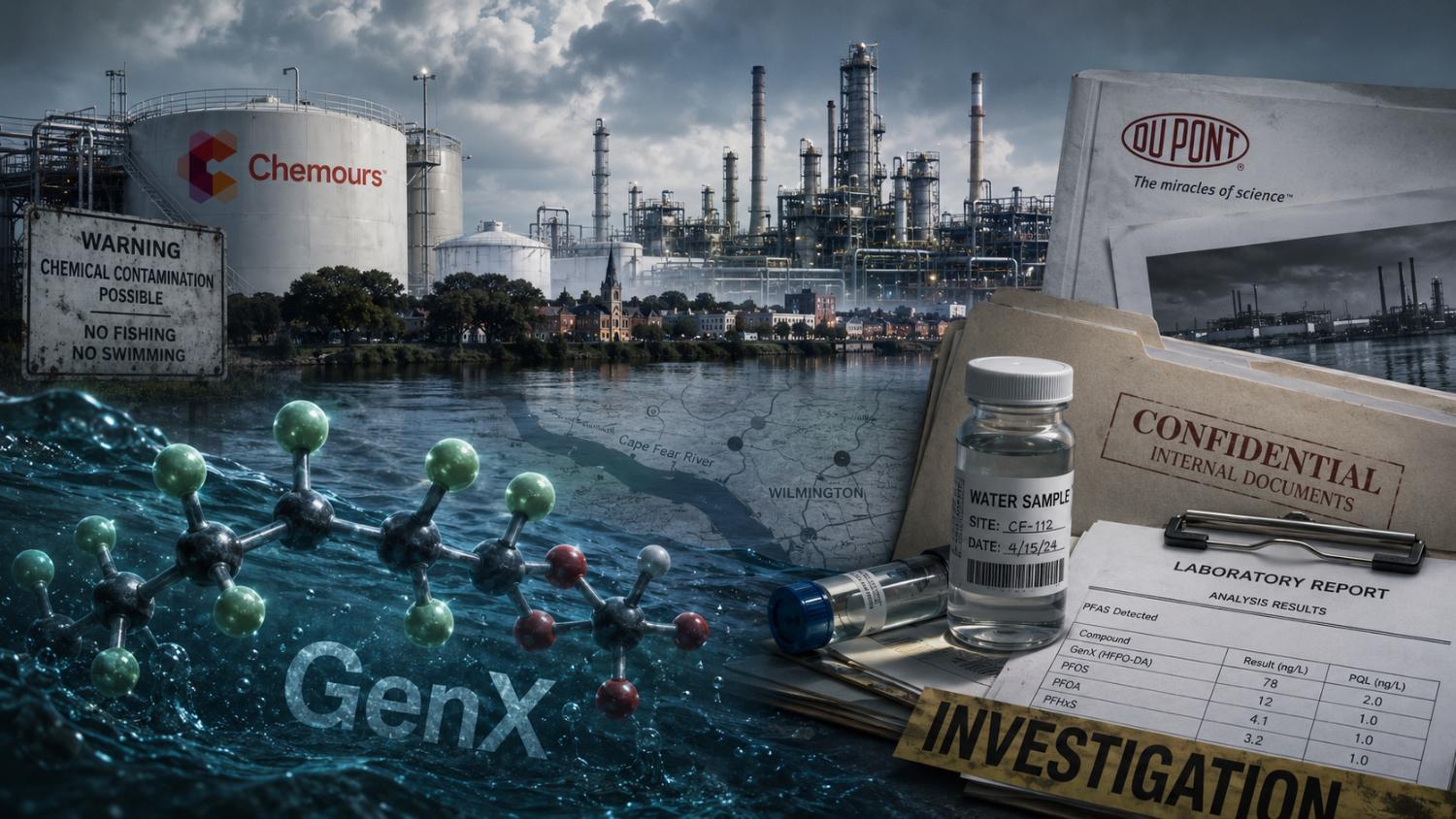
First, the chemical. DuPont agreed to phase out C8 and replaced it with GenX in 2009 — a shorter-chain compound marketed as the responsible successor. GenX has since shown a similar toxicological profile, including liver damage in animals at low doses, and has been detected in North Carolina water at 4,500 parts per trillion. The molecule changed. The problem was rebranded.
Second, the liability. In 2015 DuPont spun its chemical operations into a new company called Chemours — transferring roughly 90 percent of the liabilities to the smaller firm. Readers of our Johnson & Johnson entry will recognise the manoeuvre exactly: isolate the harm in a subsidiary, keep the profits in the parent. J&J’s courts called it the Texas Two-Step and rejected it three times. DuPont did it a decade earlier and largely got away with it.
Third, the settlements. In 2017 DuPont resolved more than 3,550 lawsuits for $671 million — while denying wrongdoing. Divide it out and the mid-Ohio Valley’s cancer patients averaged well under $200,000 each, before legal fees, for a lifetime of contamination the company had concealed for twenty years.

Where it stands
In 2024 the EPA set drinking water limits for PFOA and PFOS at 4 parts per trillion — roughly one drop in twenty Olympic swimming pools — which tells you how little of this substance is considered tolerable now that we know what it does. Enforcement lags. Many communities are still far above it.
The chemical DuPont concealed for two decades is in nearly every human body on this continent. It will be there for the rest of your life, and your children’s.

The lesson
The fine was a record. The record was a rounding error. That is not a failure of the system — that is the system, functioning as designed. A penalty calculated against a company’s conduct rather than its cash flow will always be cheaper than compliance, and every general counsel in the country knows it.
If breaking the law costs six days of revenue and buys twenty years of silence, the fine isn't a deterrent. It's a licensing fee.
Sources
- U.S. Environmental Protection Agency. “EPA Settles PFOA Case Against DuPont for Largest Environmental Administrative Penalty in Agency History,” 14 December 2005 — the primary document; $10.25 million penalty plus $6.25 million in Supplemental Environmental Projects, including the $5 million three-year fluorotelomer degradation study; Granta Nakayama quotation.
- Earth Island Journal. “Teflon’s Toxic Legacy” — Teflon sales peaking at roughly $1 billion a year in 2004 per DuPont SEC filings; PFOA in use from around 1951; the 2004 EPA lawsuit alleging concealment for more than two decades; the “single division sold more than that in a single day” assessment.
- Environmental Working Group. “Poisoned Legacy” and “DuPont Settles Big Teflon Case, But PFOA Pollution Lingers Nationwide” — the Parkersburg class action; C8 Science Panel findings; the 2006 EPA determination; and the settlement’s limits.
- CBS News. “DuPont Stuck With Big Teflon Fine,” 14 December 2005 — potential fine of more than $300 million; no admission of liability; Stacey Mobley’s “we’ve seen nothing” remark; TSCA and RCRA reporting counts.
- Contemporaneous and subsequent reporting. The 2015 Chemours spin-off; 2017 settlement of 3,550+ lawsuits for $671 million; DuPont’s pressure on EPA statements; GenX toxicity findings; C8 detected in approximately 99.7 percent of the U.S. population; and 70,000+ Parkersburg-area residents exposed above 1 ppb.
- U.S. EPA. 2024 national primary drinking water regulation setting PFOA and PFOS limits at 4 parts per trillion.
The central arithmetic in this piece — a $16.5 million penalty against approximately $1 billion in annual Teflon revenue — is drawn from the EPA’s own settlement announcement and DuPont’s own SEC filings. — Breaking the Echo Chamber